

By Jen Schumann | Rocky Mountain Voice
Colorado’s election rulebook emphasizes convenience—automatic mail ballots, long voting windows and ballot harvesting—exactly where most countries draw hard lines. That philosophical split is why Colorado lands at 50 out of 100 in a new international survey, and why the authors behind it want an on-the-record conversation with the secretary of state.
“We’d love to speak with your secretary of state… we’ll ask questions and she can ask questions,” said Gary Meyers, who co-authored the study with Jay DeLancy.
Meyers explained that The Meyers Report is a long-running research group, active for more than forty years, with contributors spread across 30 countries. “We’re interested in truth, we’re interested in fairness,” he said, describing a team that includes scientists, economists, election officials and international partners who verified country-level data.
Meyers said the project drew on “between 25 and 35 people from five continents,” making it, in his view, one of the most comprehensive comparisons of its kind.
DeLancy, a member of a North Carolina election board who helped design the survey, said the findings were meant to be put to use in real elections.
He cast the study as a risk audit built on known standards, shaped by the Carter-Baker report and common international practice. The Carter-Baker Commission, formed in 2005 after the 2000 election dispute and led by Jimmy Carter and James Baker, issued nearly 90 recommendations to strengthen U.S. elections.
The Election Rules Review survey measured the laws of all 50 U.S. states against 36 countries.
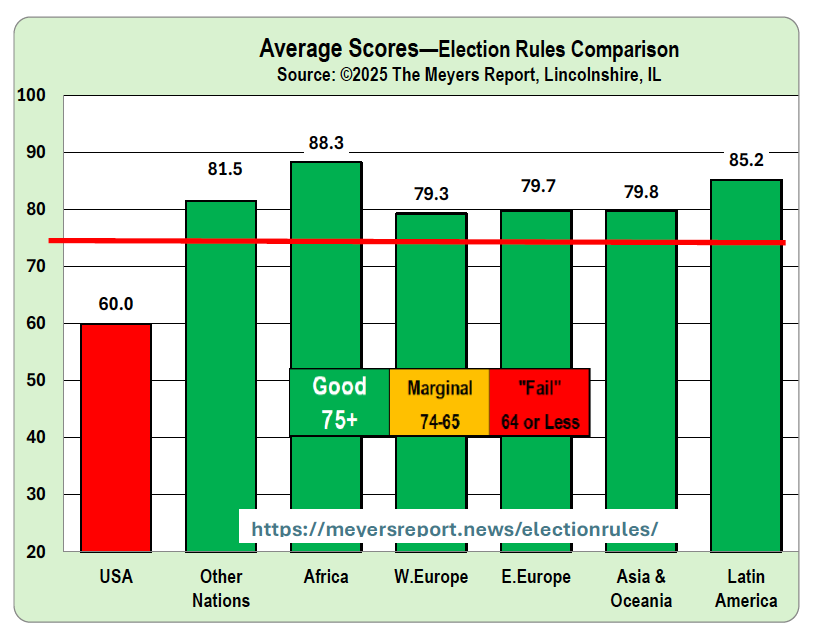
On average, U.S. states scored about 60, compared to 81.5 for the 36 nations studied. Chart from Election Rules Review (p.3) produced by The Meyers Report.
The findings led Meyers to conclude overall that, “The US has the worst voting system of the countries studied.”
Colorado’s 50: Behind the gold standard claim
When the conversation turned to Colorado, Meyers didn’t hesitate. “Colorado has a score of 50. Kenya and Mexico have scores of 95… Colorado isn’t even up to the level of Ethiopia, really,” he said. “So if your secretary of state says that you guys are the gold standard, we invite her to talk to us and please show us where our methodology is wrong.”
He noted that the study was not a casual effort. The team checked constitutions and election laws in each country and relied on overseas experts to validate the findings. The survey evaluates written rules, not whether governments follow them.
The data show why Colorado faltered. universal mail ballots and legal ballot harvesting put the state at odds with global norms. The report found that 94% of countries do not use mail-in ballots and 100% prohibit ballot harvesting, yet Colorado does both.
Meyers didn’t mince words. “Colorado is horrible… better than Illinois and Nevada, but that’s not saying much.”
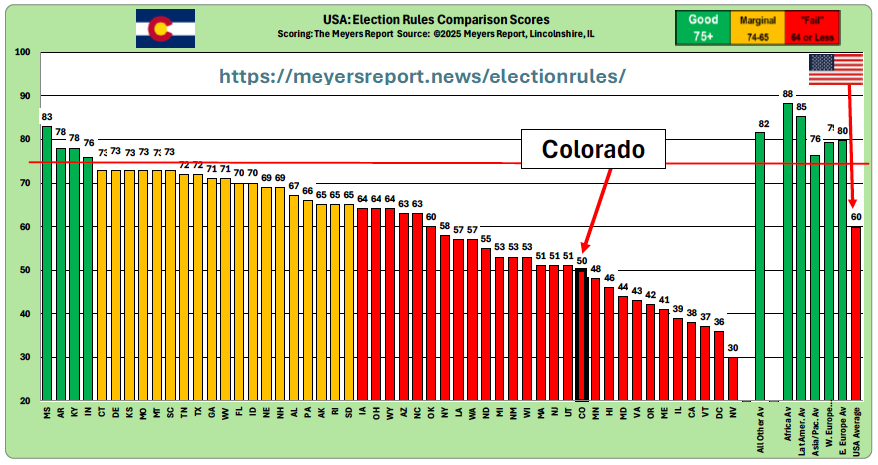
Colorado scored 50 out of 100 in the survey, ranking below the U.S. average. Chart from Election Rules Review (p.17) produced by The Meyers Report.
Ethiopia isn’t the only country that outperformed Colorado—thirty-five others did as well.
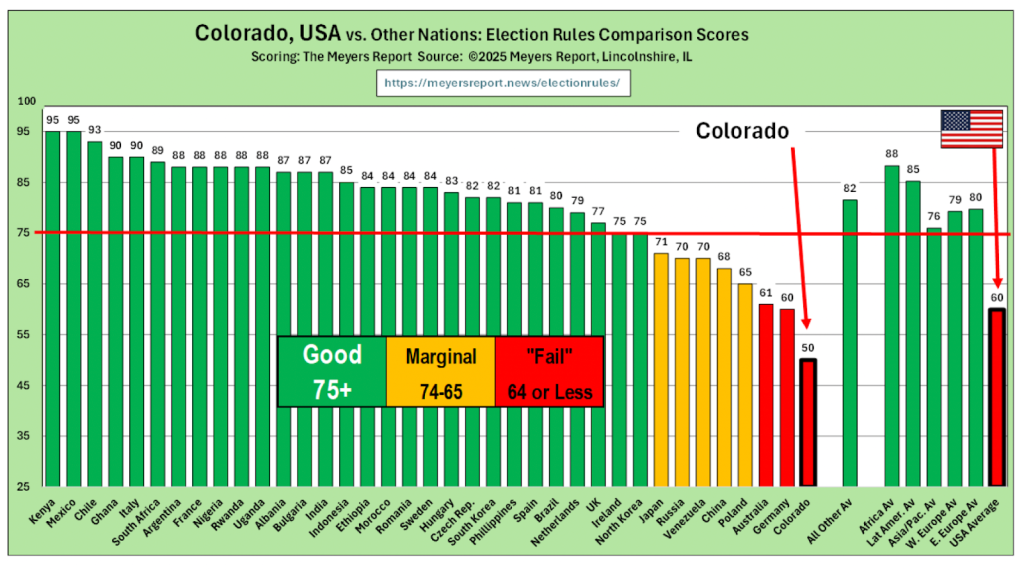
Chart from Election Rules Review (p.17) produced by The Meyers Report.
Mail-in ballots: Convenience or risk
Most of the world rejects the idea of mass mail-in voting. The survey found 94% of other nations do not allow it, while no U.S. state prohibits it. Colorado is one of only eight jurisdictions that automatically mails ballots to all active voters.
“When you have a mail-in ballot, you have zero—repeat, zero—control over the chain of custody,” Meyers said. It was the same warning raised by the Carter-Baker Commission in 2005, which found absentee voting especially vulnerable—a finding that stands out in Colorado, where every voter receives a mail ballot by default.
“No other nation studied had wide-spread mail-in ballots,” The Meyers Report press release declared. “The US is the only country that allows wide-spread unrestricted mail-in ballots for in-country voters.”
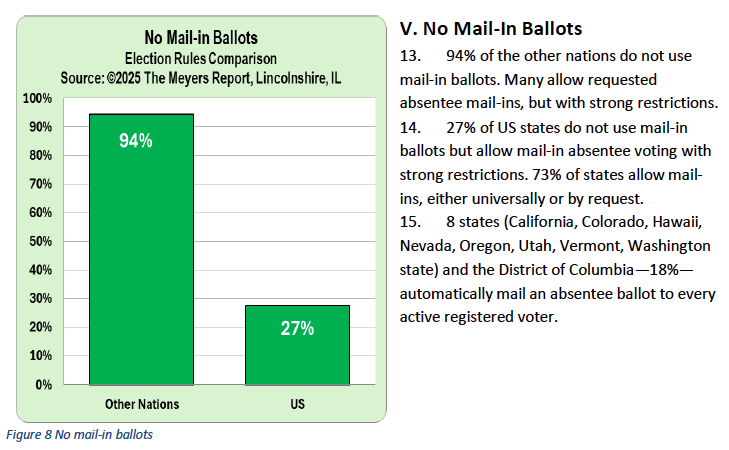
While 94% of other nations prohibit mail-in ballots, all U.S. states allow them in some form. Chart from Final International Survey Report, (p.23) produced by The Meyers Report.
Ballot harvesting: What no other nation permits
Third-party collection is another practice where Colorado stands out. The survey found that 100% of other nations prohibit ballot harvesting, yet fewer than half of U.S. states have drawn that line. Colorado allows the practice under certain conditions.
“Ballot harvesting absolutely destroys the sanctity of private voting,” says Meyers. He recalled being at a Chicago precinct meeting years ago where officials bragged they already had enough mail-in ballots “to guarantee” an election outcome. “By that point the election is fixed,” he said.
DeLancy tied it to civil rights history. “Back in the 1960s, federal law was written to stop harassment at the polls,” he said. “Now the harassment has moved to people’s front porches and nursing homes. These are bullies, not good-hearted helpers.”
The evidence in their Final International Survey Report shows that, worldwide, countries draw strict lines around who can handle another person’s ballot. “The U.S. is the only nation that allows any ballot harvesting. Ghana and China permit limited proxy voting by close family members, but nothing resembling open third-party collection.”
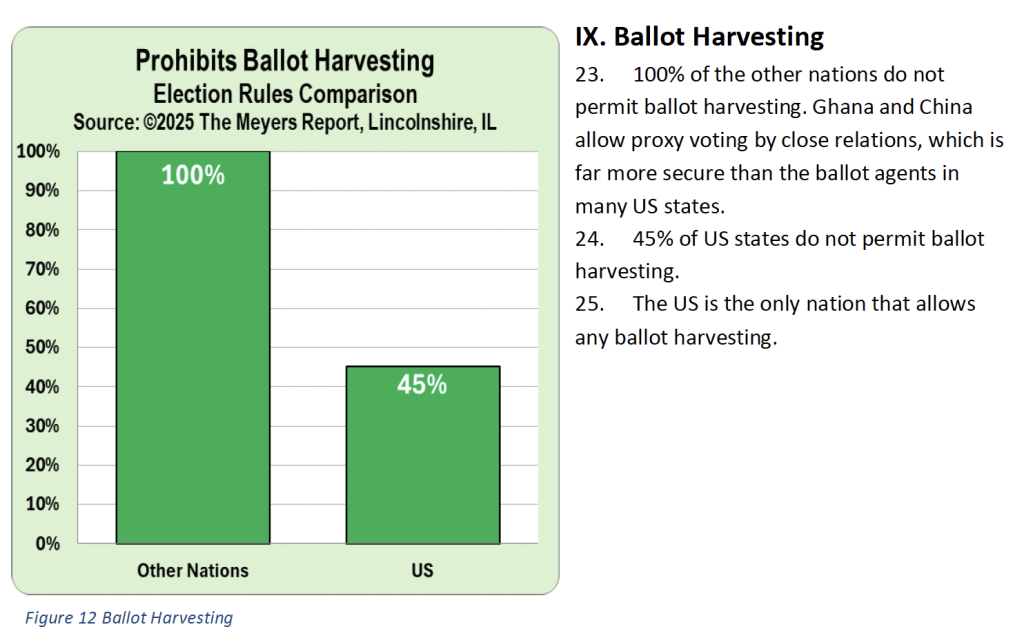
Every nation studied bans ballot harvesting. In the U.S., fewer than half of states prohibit it. Chart from Final International Survey Report, (p.25) produced by The Meyers Report.
Late-accepted ballots: Moving targets
Most nations finalize results quickly because late ballots are not accepted. In the U.S., 33% of states accept ballots after Election Day—sometimes up to three weeks later. Colorado counts ballots postmarked by Election Day if they arrive within eight days.
“As long as you have states that accept late ballots, that can delay the final count,” Meyers said. DeLancy added that “it only goes in one direction,” pointing to examples where outcomes flipped after late ballots were counted.
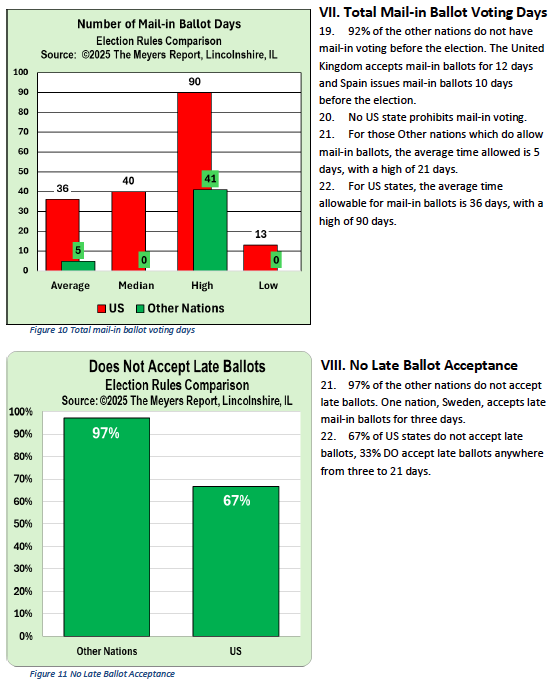
97% of other nations do not accept late ballots; one-third of U.S. states do, including Colorado. Chart from Final International Survey Report, (p.24) produced by The Meyers Report.
The honor system in Colorado elections
Best practices abroad usually mean showing proof of citizenship and a valid ID before voting. In the U.S., the report says, many states take a different path: an “honor system” that depends on voters’ word. “We are the only country surveyed that relies heavily on the honor system in any election process,” the press release stated.
Meyers put it more bluntly: “The vast majority of American states have no real requirement… they basically are doing it on the honor system.”
The analysis flagged only New Hampshire, Arizona and Wyoming as exceptions—but even those had loopholes.
In Colorado, where every active voter automatically receives a mail ballot, that reliance on trust is layered onto a system already more permissive than almost anywhere else in the world.
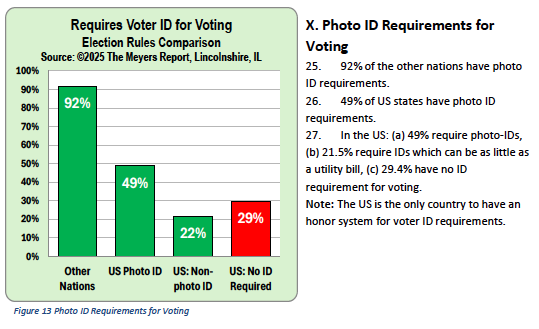
92% of nations require photo ID to vote. In the U.S., requirements vary widely by state. Chart from Final International Survey Report, (p.25) produced by The Meyers Report.
Where Colorado could improve
Meyers didn’t hesitate when asked how Colorado could move from failing to passing. “Getting rid of mail-in ballots and requiring voter ID and proof of citizenship,” he said, calling those the three most urgent fixes.
DeLancy held up Ohio’s voter ID law as the model, requiring a current driver’s license or state ID.
They underscored that the work is about future safeguards, not a replay of past fights. “We looked at it in terms of risk mitigation,” DeLancy explained. “Everything we did was to minimize the ability of people to steal through these different avenues.”
For Colorado, that leaves a direct challenge. The state’s “gold standard” claim sits against a score of 50 and a set of recommendations the authors say would be simple to implement.
Whether the secretary of state takes up Meyers’ invitation to defend that standard remains to be seen.
RMV invited the secretary of state’s office to comment on the report’s findings and will provide a follow-up story regarding any response.