
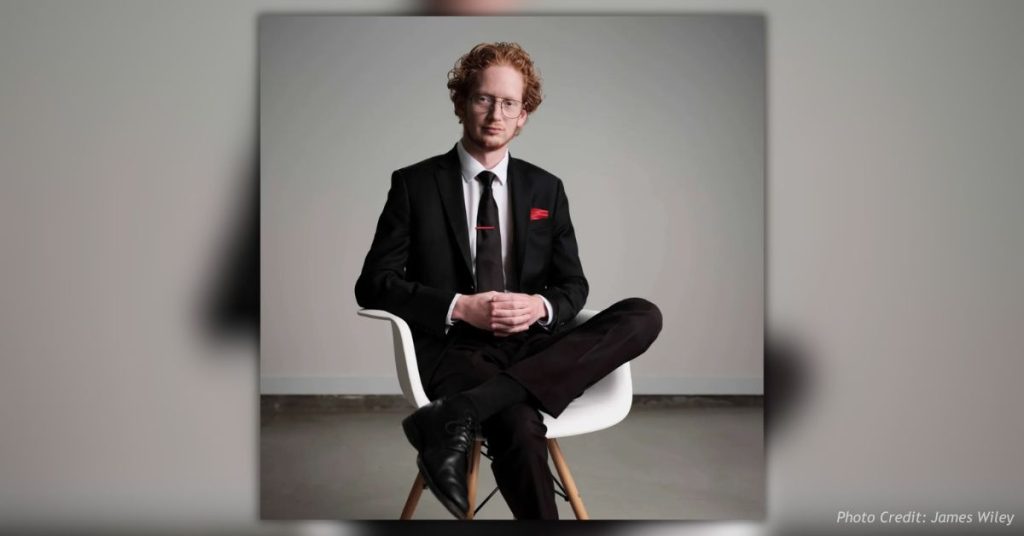
By Jen Schumann | Rocky Mountain Voice
James Wiley was 7 on Election Night 2000. He remembers the decorations from his birthday staying up for two more weeks while the country waited to find out who had won.
He didn’t understand hanging chads or voting machines. At the time, he was living in Almaty, Kazakhstan, where his missionary family had been since he was three months old.
What stuck with him from those years wasn’t the mechanics of elections. It was how power operated.
He’s 32 and running for Colorado Secretary of State as a Republican, after years working on election cases and a stint as executive director of the Libertarian Party.
What he’s saying on the campaign trail isn’t new for him. The push to get rid of electronic voting machines and move to hand-counted paper ballots grows out of years of election work—and earlier experiences growing up in Kazakhstan, where he watched the country change but said political freedom never fully followed.
From Kazakhstan to Pueblo: Learning what liberty requires
Wiley spent the first 12 years of his life in Kazakhstan, watching the transition from Soviet-era scarcity to a more open economy.
“You still had to be careful which side of the street you’re walking on,” Wiley said. “If one of the government goon squads is walking down the street, you might want to cross the road to avoid getting stopped and checked and possibly arrested.”
“Kazakhstan is technically a capitalist country,” he added. “That doesn’t mean it’s a free country.”
He was 15 when his family moved to Pueblo, attended high school there, stayed in Colorado for college and has been here since.
Around that same time, he helped take care of his grandparents near the end of their lives.
“I’m just so grateful that I could be in the country for that instead of on the other side of the planet.”
Wiley describes himself as shaped by both lived experience and study of American founding principles.
“I’m a huge fan of America,” he said. “I don’t want to give up on the American experiment.”
He often frames those ideas in terms of responsibility tied to liberty.
“The more personal responsibility that you take, the more liberty that you’re afforded as a citizen,” Wiley said.
That belief carries into his campaign identity—the “Red Flame of Liberty.”
“Without free and fair elections, we lose the correcting function that ensures our liberty.”
Six years in Colorado’s election battles
Wiley’s path into politics came through litigation.
Over the past six years, he has worked as a legal assistant alongside attorneys on election-related cases across Colorado. He was a plaintiff in the 2024 BIOS password lawsuit against Secretary of State Jena Griswold and assisted in multiple recount and election disputes, including cases tied to Tina Peters, El Paso County and Colorado’s 3rd Congressional District.
He has also worked across party lines, including assisting a Democratic candidate in a ballot access lawsuit earlier this year.
Wiley has applied to law school at the University of Denver.
“I’ve been toughened up by the last six years of the fight,” he said. “I’m not afraid of losing. I’m afraid of not fighting.”
He points to an endorsement from election integrity advocate Mark Cook as one of the most meaningful moments in his campaign.
“To see a fellow soldier endorsing my campaign… that’s the best thing that I could ask for right now,” Wiley said.
As his campaign builds, he has leaned into grassroots support.
“Please donate, redflameofliberty.com,” Wiley said. “We’re building a lot of momentum… I need volunteers.”
A different model: Rebuilding elections from the ground up
Wiley’s proposal would replace electronic voting systems with hand-counted paper ballots conducted at neighborhood schools.
He describes a system where students would train throughout the year in ballot counting and participate on election day alongside adults.
“All those schools become voting centers.”
He said the approach isn’t just about how votes are counted.
“We’ve lost that culture of participation.”
Wiley points to his grandfather as an example.
“My grandfather… he was almost blind, could barely walk,” Wiley said. “But he would make his way to the voting center and stand there and greet people as they came in.”
He said participation wasn’t about efficiency—it was about responsibility.
“That entire generation is passing away,” Wiley said. “We’ve lost that culture.”
By involving students early, he said, the system would help bring that culture back.
“They’ll understand how it works because they’ve done it.”
He also emphasized proximity.
“You can walk there,” Wiley said.
Election officials have raised concerns about hand-counting ballots at scale, including cost, speed and accuracy. Wiley disputes those concerns.
“Counties spend hundreds of thousands of dollars on electronic voting equipment,” he said. “Why can’t we spend that on people?”
State law currently requires electronic voting systems, a requirement Wiley acknowledged would present an immediate legal challenge.
He said he would interpret that requirement narrowly while pursuing broader changes.
“I’m okay with electronic voting systems,” Wiley said. “To the extent that the electricity is used to turn on the lights in the building where humans count the ballots.”
Wiley said his first step would be reviewing and reversing administrative rules issued by the Secretary of State’s office where possible.
“I’ll have my work cut out for me,” he said. “There’s a few at the top of my list I want to strike down immediately.”
He pointed to recount procedures as one example, particularly rules that rely on machine-based testing rather than full hand recounts.
For laws passed by the legislature, he said the approach would be different.
“There’s a lot that’s been made statute,” Wiley said. “That’s a bigger challenge.”
He said his approach would combine administrative changes with legal challenges and future legislative efforts.
Where he stands in the Republican field
Wiley is one of several Republican candidates seeking the nomination.
He described fellow candidate J.J. McKinzie as a strong contender with similar messaging.
“At every event… we just find ourselves agreeing with each other on almost every single point,” Wiley said.
If elected, Wiley said he would want McKinzie involved.
“I hope to have him on my campaign team… and I hope to hire him within the Secretary of State’s office as well.”
Still, Wiley said his experience sets him apart.
“I’ve been in the trenches on this issue for years.”
The Tina Peters case and what he says remains unanswered
Releasing records tied to the prosecution of former Mesa County Clerk Tina Peters is something Wiley said he would do early on if he’s elected.
“I want to find out who advised her to do that,” Wiley said.
Wiley said questions still remain about what happened in Mesa County—especially whether outside actors were involved in key decisions.
“She didn’t need to have a third-party contractor there… all that was unnecessary,” Wiley said. “Somebody advised her to do that. I want to find out who that was.”
He also pointed to possible coordination between state and federal agencies.
“I want to know what the federal government was doing in Mesa County in 2021,” Wiley said.
Wiley said he believes not everyone involved has been identified or investigated.
“Other people were involved… who were not prosecuted.”
Wiley said his goal would be to release records publicly.
“I want to release everything and let the public judge for themselves,” he added.
His focus on election systems comes as skepticism about those systems has remained steady over time.
Polling from Rasmussen Reports in 2024 showed 66% of likely U.S. voters were concerned election outcomes could be affected by cheating, while 63% said electronic systems could allow votes to be changed remotely.
That level of concern hasn’t shifted much. A February 2026 survey from the same firm again put it at 63% of voters worried about potential remote manipulation.
Other surveys have found that about half of voters say they would be willing to volunteer to hand-count ballots in a local setting.
The shoes and the test ahead
Asked who he is beyond the campaign, Wiley answered with an image instead.
He wears the same pair of Red Wing shoes every day—and has for eight years.
“I take care of that shoe,” Wiley said. “I think that’s a principle of conservatism—American heritage, American craftsmanship, American industry.”
He extends that comparison to how he views the country.
“The defense of liberty requires vigilance,” Wiley said. “Same with taking care of our shoes.”
Saturday in Pueblo is the first real test, when delegates at the Republican state assembly decide who moves on to the June primary ballot. He’ll be there vying for Republican delegates votes wearing his Red Wings.
And like the election night he remembers from his childhood, he is running on the idea that how votes are counted—and how long people are willing to wait to trust the outcome—will determine whether people believe their vote counts.