
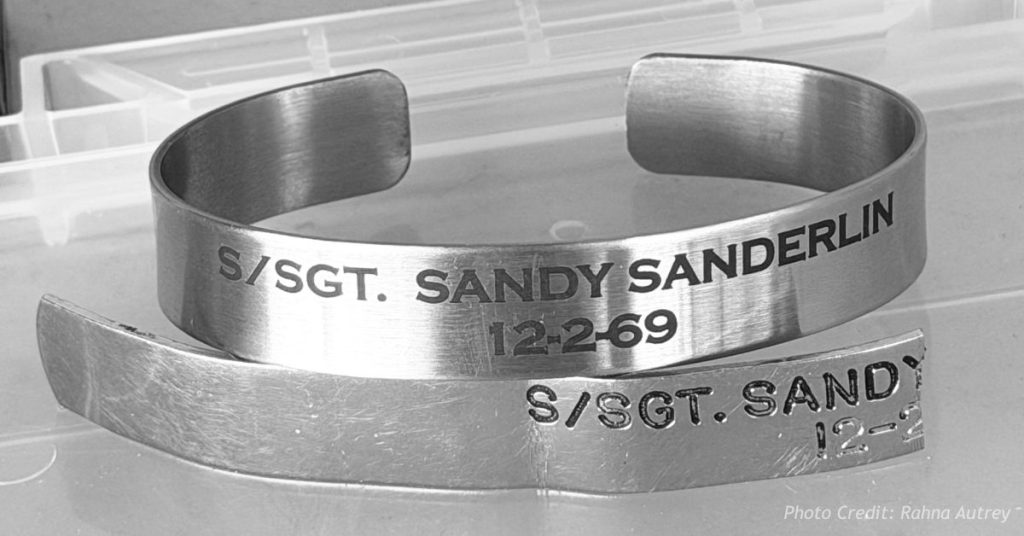
By Jen Schumann | Rocky Mountain Voice
Days before leaving on a trip she has waited 50 years to take, Rahna Autrey walked into her garage and found a face she had promised never to forget.
The tub of childhood keepsakes sat on a shelf in her garage. Inside was her seventh-grade scrapbook, Partridge Family magazines and all. Inside was the brochure that came with her bracelet. One photograph had a blue circle drawn around it.
“I couldn’t believe it,” she said. “What a God thing, huh?” The soldier was Staff Sgt. William “Sandy” Sanderlin, lost over South Vietnam on Dec. 2, 1969. She never met him. But she wore a bracelet with his name for five years, until it broke when she was a senior in high school.
Across the country in those years, Americans wore POW/MIA bracelets, each engraved for a single missing serviceman, with a pledge to keep them on until he came home or his body was returned.
Autrey leaves Fruita this week, bound for Washington and the nation’s 250th birthday with her family and stops at founding-era towns along the way.
“After so many years I believe the Lord is allowing this opportunity to bring closure for me for the young man I have carried in my heart for over 50 years since I was 12 years old.”
Beside Sandy, a photo had been cut from the page. It was her mother’s POW.
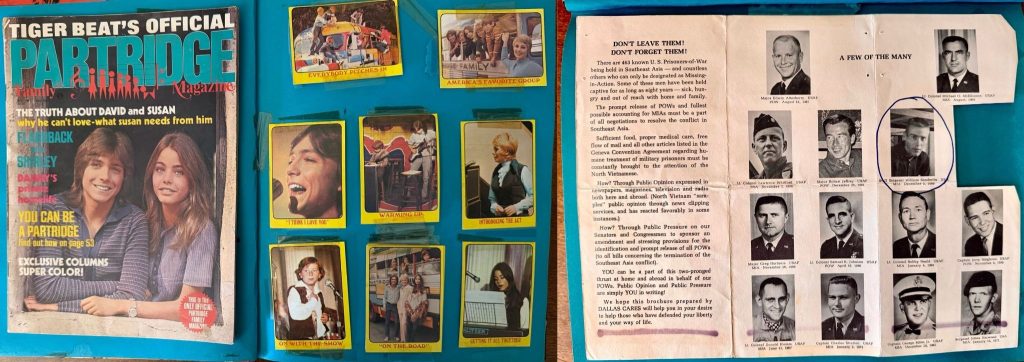
Autrey’s seventh-grade scrapbook. Photos courtesy of Rahna Autrey.
A promise made in Dallas
Her mother had heard about the bracelets and asked if she wanted one. Autrey was 12, a seventh-grader in Dallas. The war was on television every night. Her oldest brother had just graduated and joined the Navy rather than wait for the draft to send him.
“It felt like it was something I could do to support those missing,” she said. “These were guys my brother’s age.”
Mother and daughter each wore a bracelet, for two different missing men.
Hers came at random, no choosing, just the next name out. She has wondered since whether someone matched a Dallas girl to a Fort Worth soldier, but she never knew. Either way, being from the same state gave her a bond with him.
The shop stamped the bracelet with the only facts anyone had: S/Sgt. Sandy Sanderlin, 12-2-69. Sandy was a nickname, pulled from his last name.
By her senior year, Autrey was on the drill team. The instructor didn’t allow jewelry. Autrey wasn’t about to take off the bracelet. She worked out a compromise and covered it with her gloves.
When the bracelet broke before graduation, she cried. The pieces went into her jewelry box. Over the years, half of it disappeared. She kept the rest.
No name on any list
This was before the internet. A teenager in Texas had no way to find out what had become of a soldier lost half a world away. She watched the lists of returning prisoners for his name. It never appeared.
“They would publish lists of returned POWs and since I never saw his name, I never knew what happened to him.”
Her mother’s bracelet ended another way. The man whose name her mother wore had been held prisoner, then released and sent home while Autrey was still wearing hers.
She never assumed the worst. “I kinda always held out hope that he would come home,” she said, “that maybe I had just missed it.” There was no way to find out, so she stopped looking.
Life moved on. She finished school, got married and eventually moved to Colorado’s Western Slope.
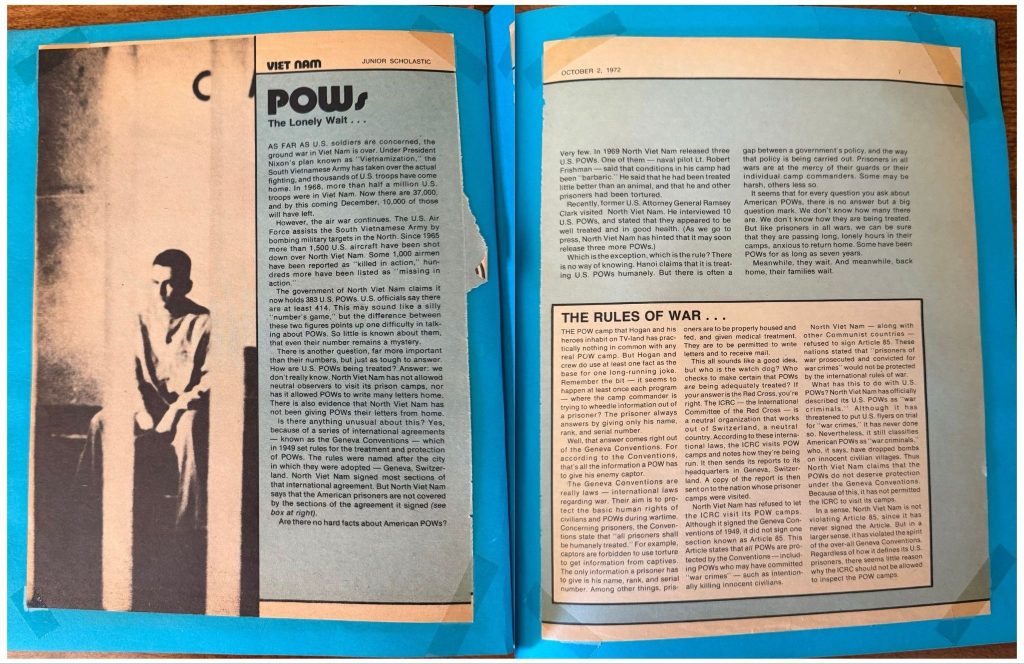
“POWs: The Lonely Wait,” an article Autrey clipped and kept as a teenager.
The helicopter in Fruita
A few years after the move, Autrey was asked to coordinate the National Day of Prayer in Fruita. She felt led to hold it at the Vietnam memorial off the interstate, the one with a Huey on display, and to honor service members, veterans, law enforcement and first responders.
Planning the event, she found herself wondering what had ever happened to her soldier.
“I got online and to my surprise I finally found out that he was killed in a helicopter crash in the same type of helicopter that’s at the Fruita memorial.” She shared his story at the prayer event.
The memorial was built as a homecoming. Near the helicopter, a bronze soldier steps toward his waiting family, set there for the men who got no such welcome.
“These guys were spit on,” she said. “It was awful.”
She has one more hope for that memorial. It adds names to its wall once or twice a year, she has learned, and she wants Sandy’s there too—at the memorial that first led her to him.
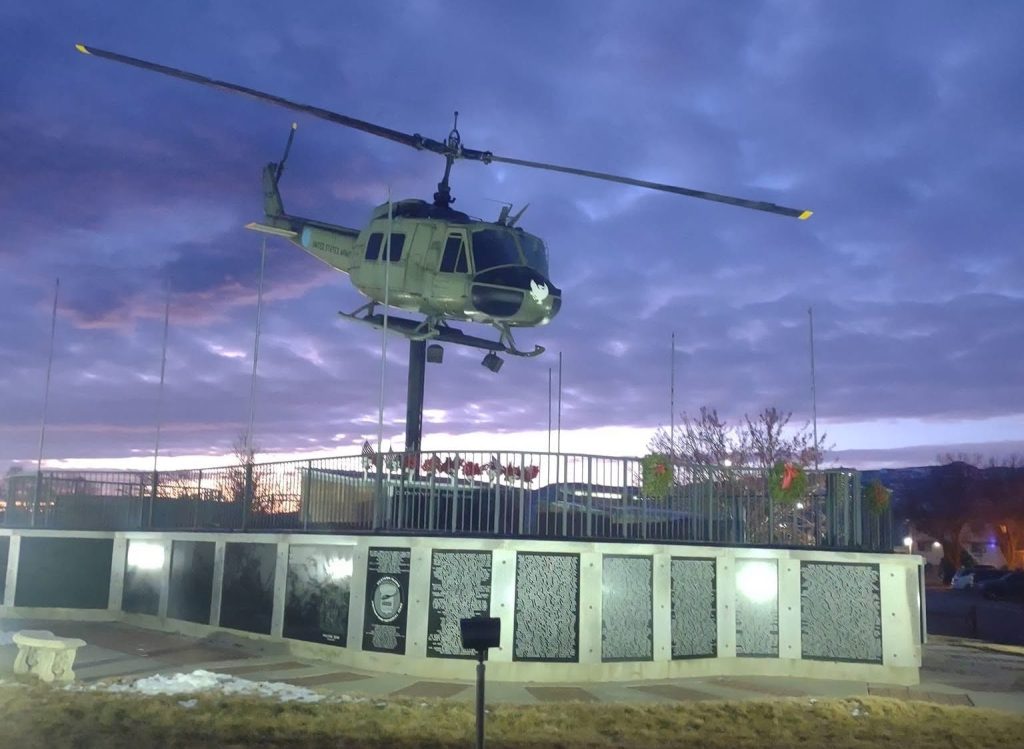
The Fruita memorial’s Huey, the kind Sandy died in. (Courtesy Western Slope Vietnam War Memorial Park – Field of Dreams via Facebook)
What happened to Sandy Sanderlin
The records fill in what Autrey could not learn as a girl.
His name was William Dale Sanderlin. Born in Fort Worth on Sept. 15, 1943, he joined the Army and served as a crew chief with the 129th Aviation Company. On the night of Dec. 2, 1969, he was aboard a UH-1B Huey gunship, the second of two, flying fire support for a long-range reconnaissance patrol in Binh Dinh Province. He was 26.
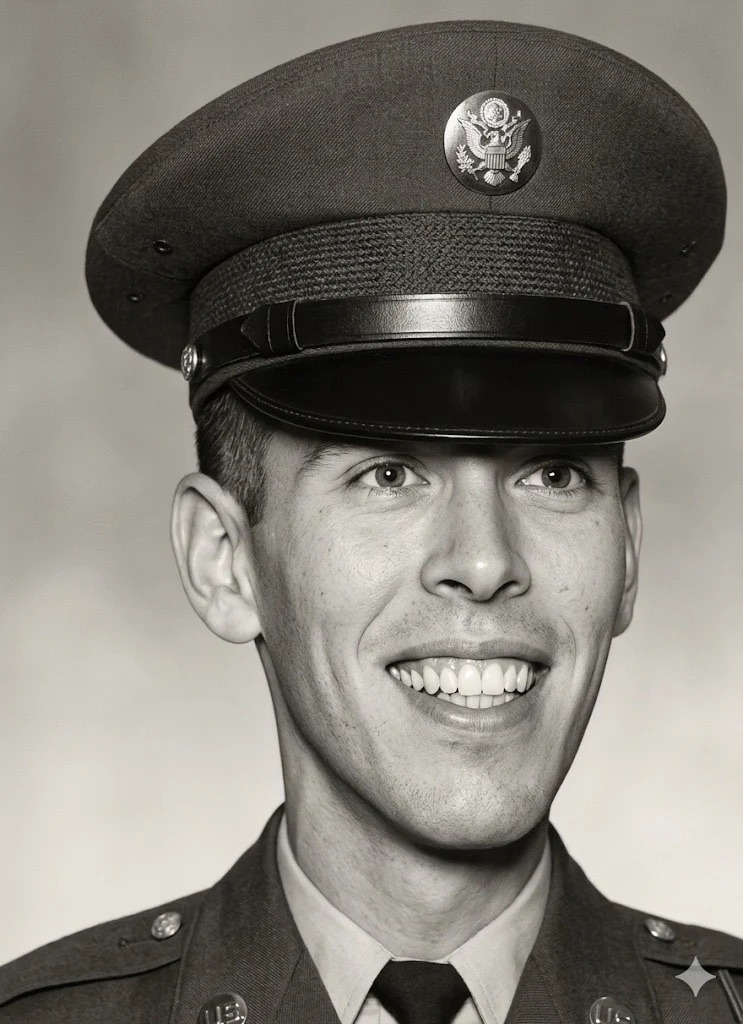
Staff Sgt. William “Sandy” Sanderlin, 26 when his Huey went down. (Photo: Vietnam Veterans Memorial Fund, Wall of Faces)
The helicopter disappeared in a stretch known as the “graveyard of helicopters.”
A Vietnamese woman later told a board of inquiry she had seen the helicopter go down and the crew taken by the Viet Cong. No wreckage turned up. For about 20 years the four were listed as prisoners of war, dead or alive, with no way to know which.
In January 1989 the Vietnamese government returned a set of remains from the area where he went missing.
“It took them a whole year to identify who they were, and he was one of them.”
Forensic analysis identified him on Feb. 22, 1990. He is buried at Arlington National Cemetery. His name is on the Vietnam Veterans Memorial in Washington, at Panel 15W, Line 18.
Autrey was not the only stranger to wear his name.
On the Wall of Faces, an online tribute page for every name on the Wall, others have left notes for Sandy. Two women wrote that they wore his bracelet as teenagers, year after year, until it broke, the same as Autrey. Another found hers in a drawer decades later. A man named Glenn Aichlmayr wrote that he picked Sandy’s bracelet while he was still in Vietnam in 1971, drawn to the first name, and kept it on after he came home.
Two college students and 5 million bracelets
The bracelets began with two college students. Carol Bates and Kay Hunter started them through a Los Angeles group called Voices in Vital America, after a local television host introduced them to the wives of missing pilots in late 1969. They wanted to support the prisoners without wading into the fight over the war itself.
A bracelet cost $2.50, about what a movie ticket cost at the time. The campaign officially began on Veterans Day 1970. By the time the group shut down six years later, nearly five million bracelets had been sent out nationwide.
Autrey credits those two students with something larger than the bracelets.
“Those two girls, in college, took this, and at one point they were getting orders 12,000 a day,” she said. “They literally helped change the culture of this country to honor the soldiers that were fighting the wars they didn’t want to be any part of.”
Three generations head east
Thinking about the trip, Autrey found an organization still making the bracelets and ordered a replica of Sandy’s. She will wear it east.
Eight are going, three generations in all: Autrey and her husband, their son, daughter-in-law and four grandchildren.
The route runs through the country’s beginnings. Colonial Williamsburg first, which is marking the 250th, then Jamestown, then several days in Annapolis. Somewhere in there is a day and a half at the beach where her daughter-in-law grew up.
By the Fourth, they’ll be on the National Mall for an All-American Fair featuring all 50 states.
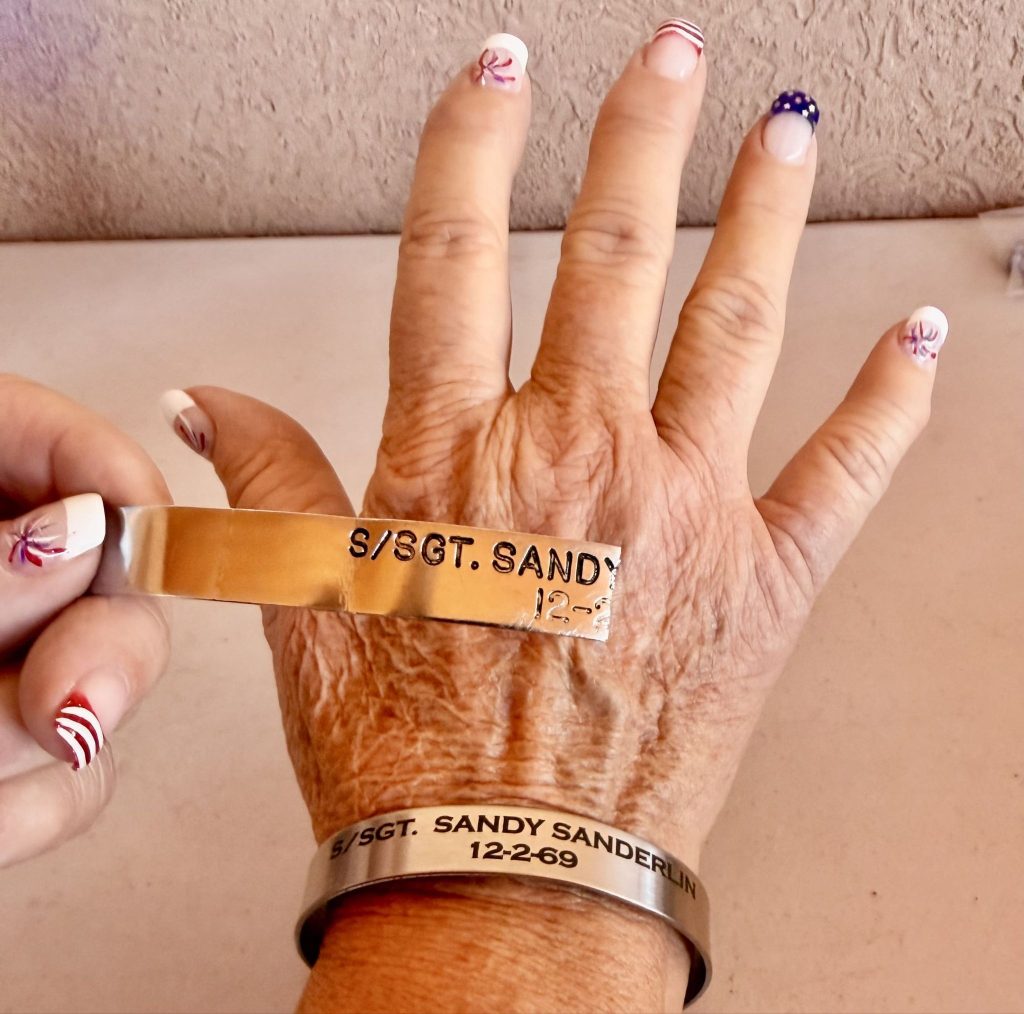
Autrey holds the broken half of her original bracelet, the replica on her wrist.
His name on the Wall
She will watch the changing of the guard at the Tomb of the Unknown Soldier, then go looking for Sanderlin’s grave. Autrey has already found the plot online, close to where the ceremony is held.
She has not planned what to say when she gets there. What she has is gratitude, for Sandy and for the rest of them.
“They gave the ultimate sacrifice that we could be free.”
For Autrey, Sanderlin was never only one man.
“He’s just representative of all the guys that went over there,” she said. “He died young, and we lost a lot.”
It started in 1972 with her mother and a brochure. Two bracelets, two missing men, a mother and her 12-year-old. Now the daughter is driving east with her own children and grandchildren, and Sandy’s name is going with them.
Fifty years is a long time to hold onto a stranger’s name. “I can’t believe after this many years it still affects me this much.”
At the Wall, she will find Panel 15W, Line 18, and make a rubbing of his name to bring home.
“I just want him to be honored,” Autrey said.