
By Shaina Cole | Contributing Writer, Rocky Mountain Voice
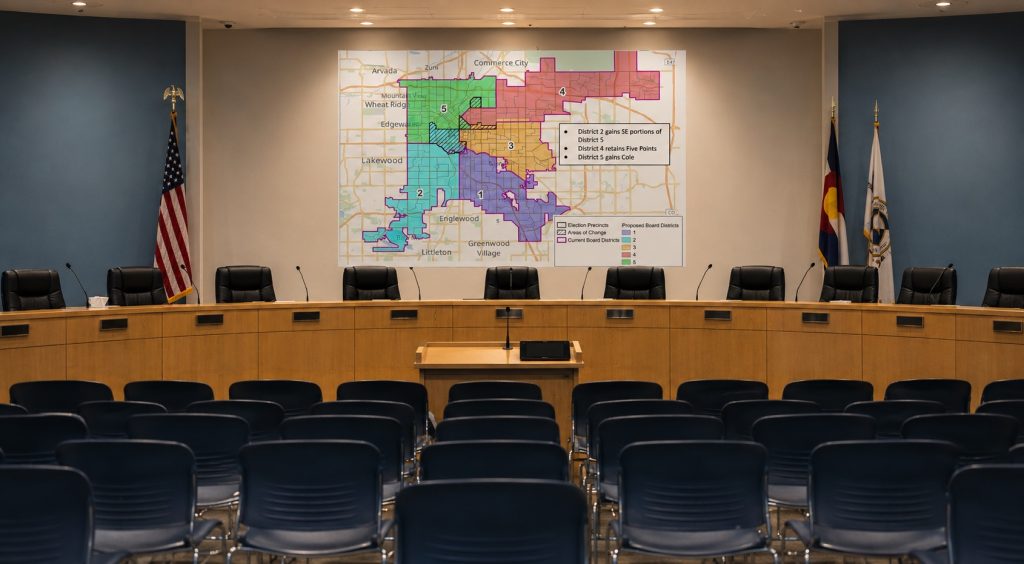
A conservative election-law firm filed a federal lawsuit against the Denver Public Schools Board of Education on July 2, arguing the board deliberately drew its school district voting map along racial lines. The board’s own words, the suit says, prove it.
The suit was filed in U.S. District Court in Colorado by the Public Interest Legal Foundation, a Virginia-based nonprofit, on behalf of Denver residents Susan Moore and Valdamar Archuleta. It targets Map C, the redistricting plan DPS adopted in April 2024 following the 2020 census.
The complaint does not just allege that race played a role. It argues race was the point.
What DPS did
After each federal census, Colorado law requires school districts to redraw their board districts so each is “as nearly equal in population as possible,” per C.R.S. § 22-31-109(2)(c). State statute also requires districts to be contiguous, compact, and composed of whole precincts. Race is not mentioned anywhere in the law.
Following the 2020 count, DPS found that its existing map had drifted significantly. District 4 had grown too large. District 2 had grown too small. The deviation between the largest and smallest district had reached 24 percent, well above the 10 percent ceiling the U.S. Supreme Court has identified as the threshold for compliance. Something had to change.
DPS staff put together three options. Maps A, B, and C each rebalanced the population differently, and staff evaluated all three against four criteria: population balance, racial and ethnic concentration, compactness, and community feedback.
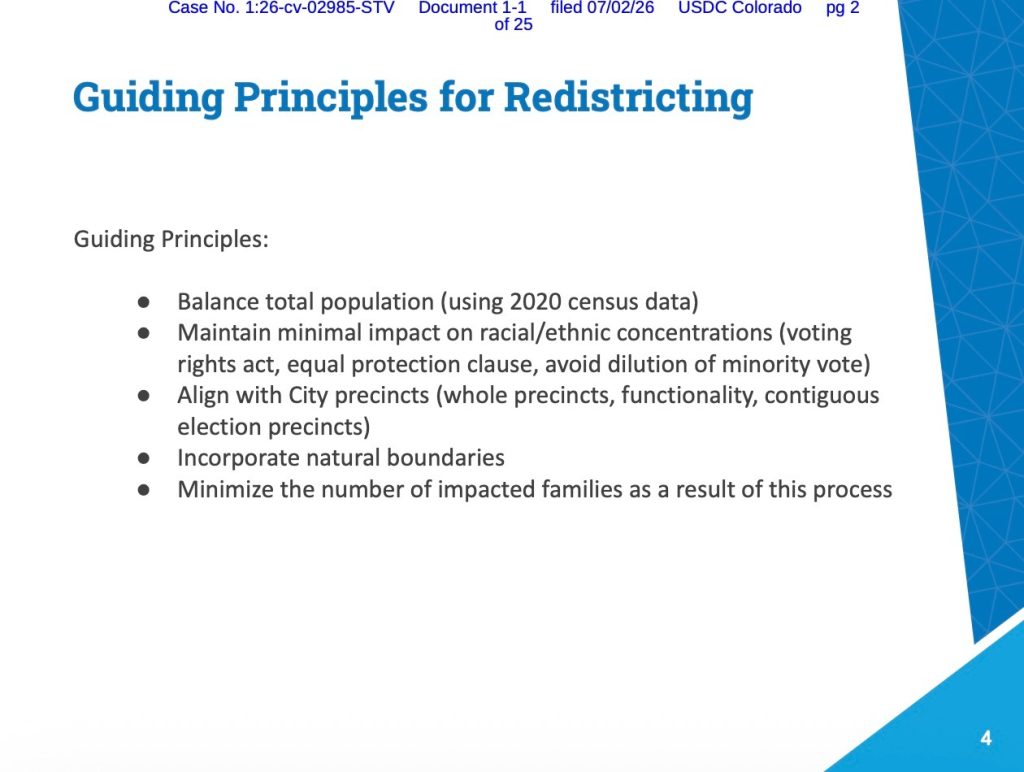
DPS’s own guiding principles listed racial and ethnic concentration as a criterion alongside population balance and compactness.
DPS’s own summary slide rated each map across those four criteria. Map A earned the top mark on population balance and community feedback. Map B earned the top mark on the criterion most central to this lawsuit, its impact on racial and ethnic concentration. Map C earned no top marks and drew the only “degree of concern” rating of any scenario, for compactness.
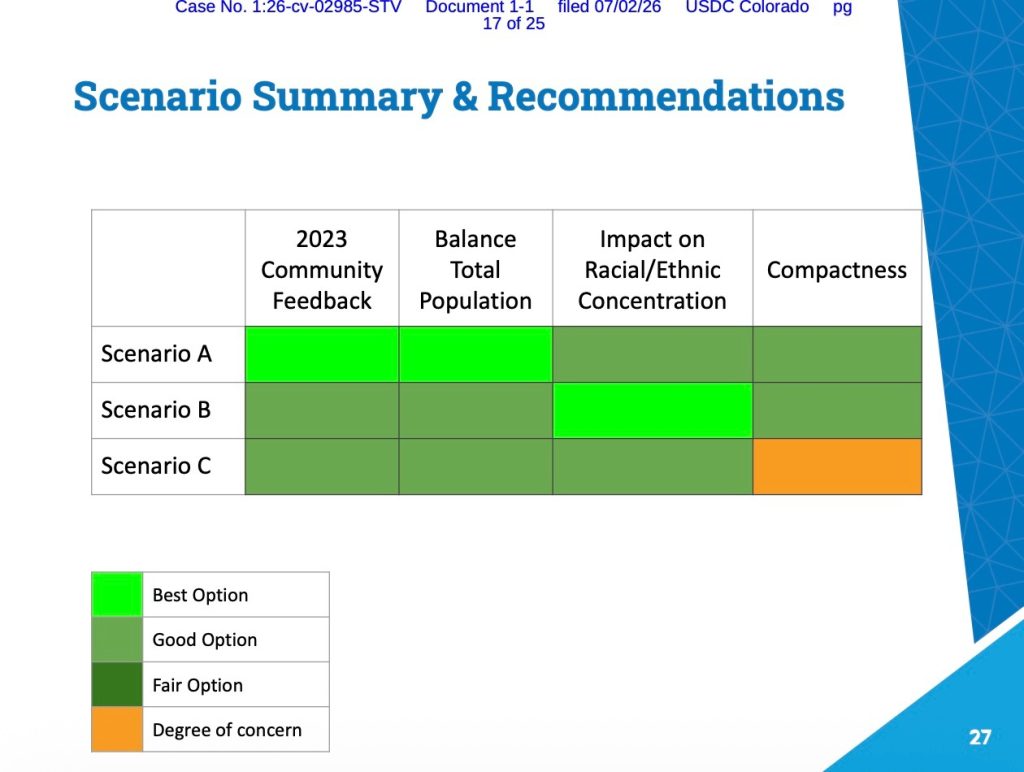
DPS’s own summary rated Map A highest on population balance and community feedback, Map B highest on racial and ethnic concentration, and Map C lowest overall — earning the only “degree of concern” rating in the entire grid, for compactness.
The board chose Map C.
What the map changed
The fight, as it turned out, was over one neighborhood cluster in northeast Denver.
Five Points and Whittier are historically Black neighborhoods that had long sat inside District 4, which had often elected a Black school board member. Under Map A, Five Points would have moved out of District 4 into District 5. Under Map C, both neighborhoods stayed — and District 4 was stretched geographically to keep them there.
DPS’s own redistricting presentation flagged the problem, noting that stretching District 4 from the far northeast to Five Points in Scenario C made it less compact than Scenario A. The board chose it anyway.
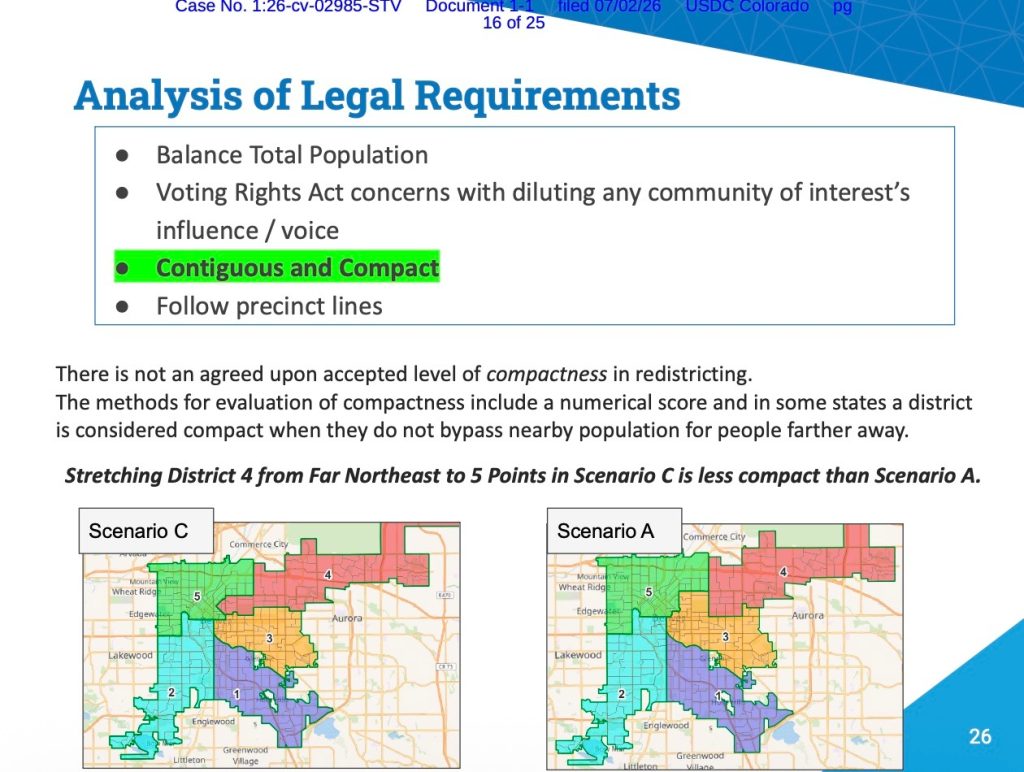
DPS’s own presentation showed District 4 under Map C was less compact than under Map A, with the district stretched to retain Five Points.
The racial composition numbers tell a similar story. Under the existing map before redistricting, District 4 was 19.08 percent Black. Under Map C, that share ticks up to 19.90 percent. Under Map A, it would have dropped slightly, to 19.02 percent. The difference between the maps is less than one percentage point, but the board’s stated reasoning for the choice was not demographic precision. It was representation.
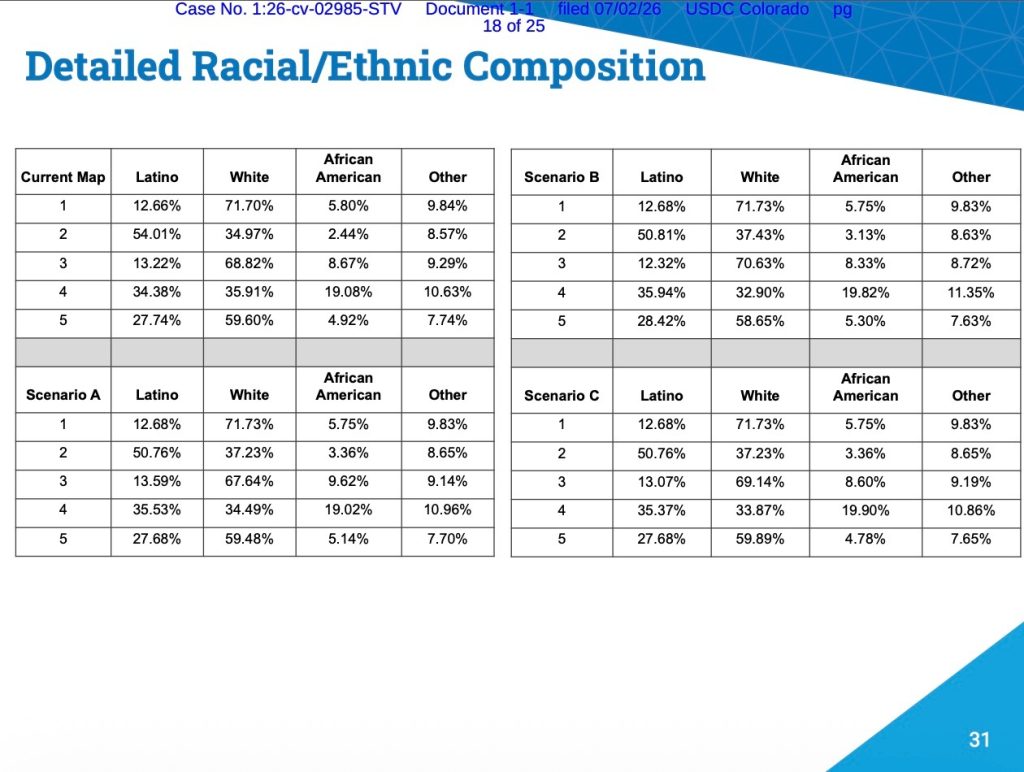
DPS’s own presentation tracked the racial and ethnic breakdown of all five districts under each proposed map. The figures cited in the lawsuit appear in full here.
District 2 in southwest Denver expanded under Map C to pull in Latino neighborhoods including Sun Valley and La Alma/Lincoln Park from neighboring districts. The Latino share in District 2 dropped from 54.01 percent under the old map to 50.76 percent under Map C, as the district grew in size, but the board said the goal was to preserve Latino influence in that seat.
What board members said
The lawsuit draws heavily on statements board members made in public during the April 2024 meeting where Map C was adopted.
Board member Scott Esserman said “[t]hat our students being represented by people who look like them is really important, and that for now, we don’t have to make the decision for 10 years down the road, or I guess less now… And so for me, the representation, the map that potentially enshrines representation in what has been traditional representation, is Map C.”
Then-Board President Carrie Olson framed the vote in terms of resisting gentrification, saying “[h]ow do you stop some of the inevitable things that are happening in our country, with gentrification, with communities of color being pushed out.” She also said “[w]e can’t stop where people move and who lives there, but we can, at least for the next seven years [time before the next federal census], make sure those cultural icons are preserved.”
Board member Michelle Quattlebaum said “I extend my heartfelt appreciation to the members of the Latinx community who have stood shoulder to shoulder with the Black community in advocating for equity. It is through this solidarity and recognition of shared struggles that we forge a path forward towards meaningful change. We must acknowledge the pivotal role of history in our quest for justice by understanding and confronting the legacy of oppression rooted in White supremacy. We paved the way for transformative action.”
Board Vice President Auon’tai Anderson, who also serves as CEO of the Center for Advancing Black Excellence in Education, is described in the complaint as expressing concerns over the risk of disenfranchising Black voters because of the increased number of White Denver residents.
At-large member John Youngquist said “community of interest is a piece that is especially of importance of value to me, as a White man serving and leading within our community, I want to listen to [as much] feedback [from] communities of color as I can to understand, make a decision [that] is of value to the community.”
Not every board member supported Map C. Xóchitl Gaytán, now the board’s president, and Marlene De La Rosa, now the board’s secretary, voted for Map B instead. Both said Map B had drawn the most support in a community survey.
De La Rosa said during the meeting that “as a board, we must base our decision on population numbers from 2020 and the specific legal requirements set forth in state law. We must also consider the impact on racial and ethnic concentrations in accordance with the Voting Rights Act and the US Constitution’s Equal Protection Clause to ensure we avoid dilution of the minority vote.” Gaytán said “[i]t speaks to the concerns of our communities, our communities of color, the Black and Brown voices, and how they get diluted, right?”
Former board candidate Alexis Menocal Harrigan wrote afterward that “the common theme among Map C supporters was that it kept historically Black communities in a district historically held by Black board members.”
The legal argument
A claim under the Fifteenth Amendment is legally distinct from one under the Fourteenth Amendment. By filing under the Fifteenth, PILF aims to close a loophole DPS would otherwise have.
The Fourteenth Amendment prohibits racial discrimination but allows a government to defend its actions if it can show a compelling reason for them, leaving room to argue that race was considered in order to comply with the Voting Rights Act. The Fifteenth Amendment, which guarantees that the right to vote cannot be “denied or abridged” on account of race, carries no such escape. The complaint cites the Fifth Circuit’s ruling in Prejean v. Foster for the proposition that “there is no room for a compelling state interest defense, as the Fifteenth Amendment’s prohibition is absolute.”
By that logic, DPS would have no room to claim it drew the map to protect minority voters under the VRA. PILF said in a statement to RMV that the VRA defense “is only available in a 14th amendment case” and does not apply here. The complaint cites Velasquez v. City of Abilene for the proposition that “racial discrimination need only be one purpose, and not even a primary purpose, of an official act” to violate the prohibition on election procedures enacted with racially discriminatory intent.
The lawsuit also argues that even if DPS had tried to justify its map as a VRA compliance measure, it skipped required legal analysis — the complaint says no analysis under Thornburg v. Gingles, a 1986 Supreme Court case, was conducted at all. PILF cites Louisiana v. Callais, a 2026 Supreme Court decision, as additional authority for the position that using race to draw legislative districts is prohibited outside of very narrow remedial circumstances.
J. Christian Adams, PILF’s president and general counsel, said in a statement: “Race may not be used to allocate political power in the United States. Using race to draw school district lines in Denver offends that principle and is contrary to the American ideal.”
What the lawsuit asks for
The plaintiffs want a federal judge to declare Map C unconstitutional, enjoin DPS from any further use of it, and order the board to draw a new map without using any racial criteria. They are also seeking damages and attorneys’ fees.
Map C is currently in effect. It was used in the November 2025 board elections, and the next regularly scheduled election under it is in November 2027. Asked whether PILF intends to seek a preliminary injunction to block the map before the next election, PILF communications staff said that question is not yet determined.
Scott Pribble, DPS Director of External Communications, said the district is not able to respond to questions due to the open litigation.