
By Mike O’Donnell | Guest Commentary, Rocky Mountain Voice
Colorado relies on the U.S. Postal Service to deliver millions of ballots, but the mail carrier isn't always the last person to handle them. In Part 4, Mike O'Donnell examines Colorado's chain of custody—from group homes and shelters to commercial mail locations, drop boxes and ballot harvesting.
Ballot Chain of Custody
Because Colorado is a vote-by-mail state, the U.S. Postal Service, as a (mostly) trusted agency of the federal government, is the primary delivery mechanism used to ensure that ballots are delivered to all active status registrants.
Colorado ballots are, for the most part, delivered by U.S. Postal Service workers directly into the home mailboxes or secure mail boxes at local post offices for active status registrants in Colorado. Because mailboxes are considered federal property and protected under U.S. law, bad actors who interfere with ballots delivered by U.S. Postal Service workers can be—and are—charged with serious crimes.
But the U.S. Postal Service isn’t the sole mechanism used to deliver ballots in Colorado. UOCAVA ballots are ‘delivered’ electronically and a large number of ballots are delivered en masse to intermediaries by the U.S. Postal Service, and that intermediary is then officially or unofficially responsible for delivering individual ballots to the appropriate registrants.
Statutes highlight two situations where supervised intermediaries must be involved in delivering ballots one step removed from the U.S. Postal Service.
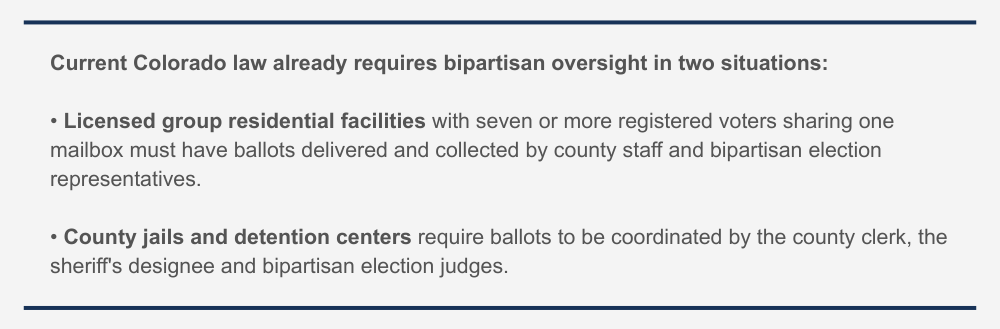
Statute 1-7.5-113 requires that where seven or more active status registrants share a mailbox at a group residential facility, a representative of the county clerk and representatives of both of the Democrat and Republican parties are charged with both delivering and collecting ballots. “Colorado defines a group residential facility as a state-licensed dwelling where groups of unrelated individuals, such as persons with intellectual/developmental disabilities, mental health conditions, or older adults, live together as a single housekeeping unit while receiving care, supervision, or protective oversight by professional staff.”
Statute 1-7.5-113.5 requires that ballots for registrants at a county jail or detention center are both delivered and coordinated by the county clerk and a trained designee of the sheriff who is charged with collecting and securely storing completed ballots until a team of bipartisan election judges, acting at the direction of the county clerk, retrieves them. (Only individuals detained or incarcerated for a felony conviction are prohibited from voting in Colorado.)
While guard rails are in place for group homes and county prisons, the Secretary of State has no qualms whatsoever about the hundreds upon hundreds of ballots delivered to other drop-off points where an unsupervised intermediary takes over the delivery process from the U.S. Postal Service worker.
For example, even though there is the possibility that some of the state’s homeless population might be experiencing the same sort of challenges associated with mental acuity or the ingestion of medications that some residents of licensed group homes may be experiencing, there is no oversight of ballots delivered in large numbers to shelters, mental health facilities and food banks where many homeless Coloradans receive ballots.
The St. Francis Center on Curtis Street is one of the largest homeless shelters in the state and received 365 ballots to distribute for the current primary election. It remains the sole responsibility of the St. Francis Center staff to handle the logistics of ensuring ballots are delivered to each individual registrant on a timely basis.
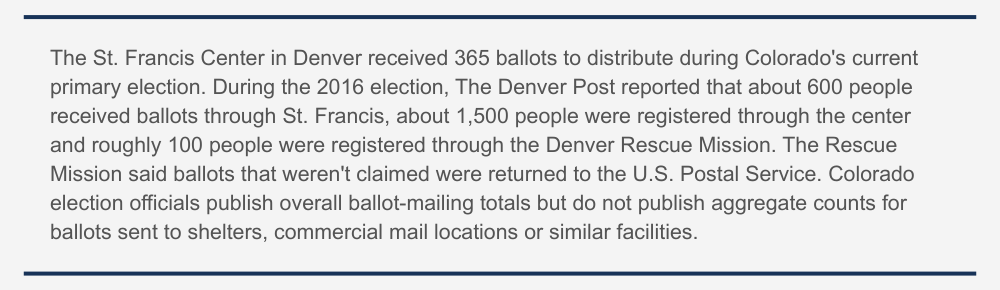
College residence halls, dorms, large boarding schools, dude ranches, spiritual centers and all sorts of other types of unlicensed group homes or businesses where seven or more registrants share a single mail receptacle, are located all across the state of Colorado. Many receive a significantly large number of ballots to distribute, all one step removed from the chain of custody provided by the U.S. Postal Service.
Additionally, because the U.S. Postal Service doesn’t always offer home mail delivery, if local residents don’t have access to or can’t afford a post office box, they may choose to collect their mail at other commercial mail distribution locations.
In the town of Breckenridge, for example, of the 927 individual ballots mailed to the local UPS store, only 166 registrants list a private mail box number on their Colorado record mailing address. This means that the other 761 registrants have to collect their ballots from a staff member at the front counter of the UPS store during regular office hours.
The Colorado Secretary of State doesn’t seem to have any chain of custody qualms, concerns or issues associated with large quantities of ballots being distributed by unsupervised intermediaries, although there is certainly the potential for issues to arise.
Chain of custody concerns could also arise as a completed ballot makes its way back to the election center.
Colorado’s legislature recently enacted House Bill 26-1113 to increase the number of and expand the hours of ballot drop-off box locations around the state for the federal election later this year. There have been instances in the past where ballots weren’t collected from drop-off boxes (famously in Mesa County in 2020, when 574 ballots were found unopened and uncounted three months after an election) and standalone ballot drop-off boxes seem to be increasingly targeted and damaged by violent agitators in states such as California.
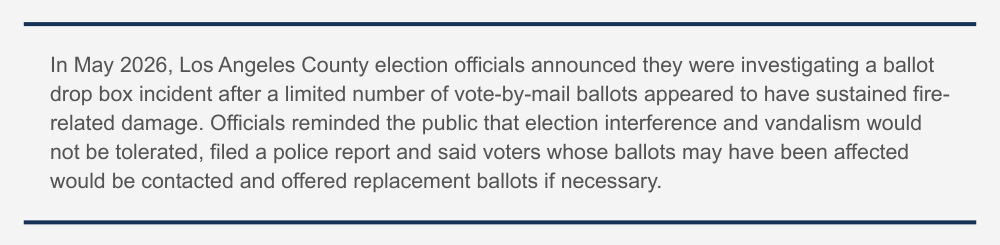
Depositing a ballot in an unguarded, standalone drop-off box isn’t as secure as returning it in person to a polling place or voting in person at a polling place. (Then again, returning it in the mail isn’t 100% guaranteed either.)
Ballot Harvesting
Colorado statutes allow for a limited form of ballot harvesting, also known as ballot gathering, providing that no one other than “a duly authorized agent of the county clerk’s office or a designated election official, may receive more than ten mail ballots in any election for mailing or delivery.”
However, in this world of conveniently located ballot drop-off boxes, there is no effective way to monitor potential instances where someone violates Colorado’s ten ballot limit.
Because the Secretary of State is a big advocate of encouraging out-of-state students at Colorado institutions of higher learning to register to vote in the state (knowing that most will vote for Democrat candidates), many of those students will remain as active status registrants on the Colorado voter roll LONG after finishing their studies and returning to their home state. (They will rarely withdraw their Colorado registrations and almost never file a NCOA). This means that dumpsters at colleges all around the state fill up with discarded Colorado ballots each election cycle.
From what I’m led to understand happens, it is potentially an easy matter for a bad actor to dumpster-dive hundreds of discarded ballots from trash bins located behind college residence halls or dorms during election season, illegally complete those ballots on behalf of long absent registrants, scribble a signature on the back of the return envelope (most college students haven’t learnt cursive so their signatures aren’t very distinctive), fill up a backpack with sealed ballots, don an Antifa mask, charge up their e-scooter or e-bike (they are usually fat and have trouble getting around under their own power), and zip around depositing ballots in various drop-off boxes.
Ballot drop-off boxes make Colorado’s existing limit of gathering no more than ten ballots both irrelevant and unenforceable.
Mike O’Donnell is a small business advocate, nonprofit executive and economic development leader based in Kirk, Colorado. He currently serves as Executive Director of Prairie Rose Development Corp., a mission-driven lender supporting underserved entrepreneurs across the state.
Editor’s note: This is Part 4 of a seven-part guest commentary series examining Colorado’s voter registration system and voter roll through the author’s review of publicly available records and other cited sources. Read Part 1: Getting on is the easy part, Part 2: Getting off isn’t so easy and Part 3: Where the ballots go. Coming next: Part 5: Duplicate registrations. Opinions expressed in commentary pieces are those of the author and do not necessarily reflect the views of Rocky Mountain Voice, but we support the constitutional right of authors to express those opinions.