
By Mike O’Donnell | Guest Commentary, Rocky Mountain Voice
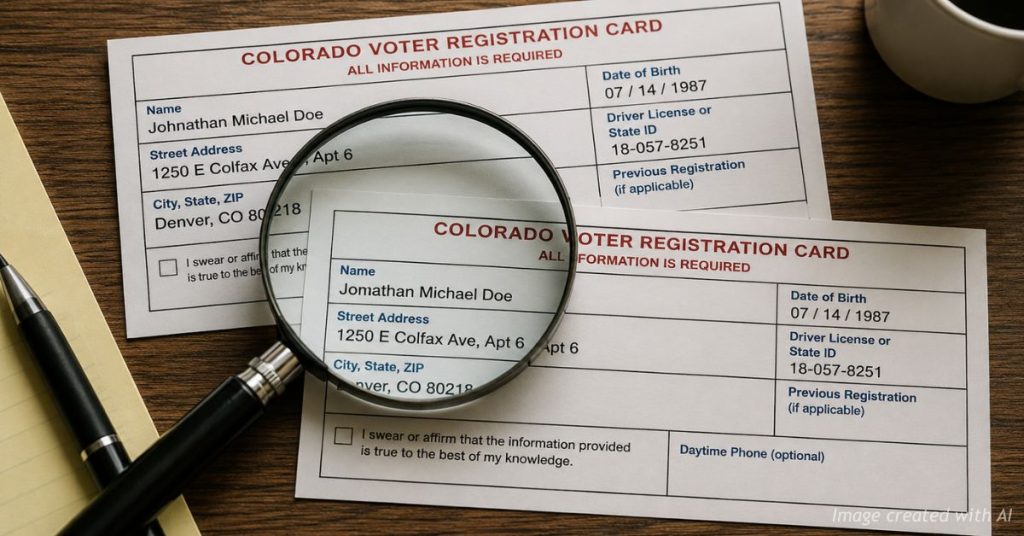
A voter registration is intended to identify one eligible voter. In Part 5, Mike O'Donnell shares examples he flagged during a manual review of more than 412,000 Colorado voter records that he says appear to show duplicate registrations created by small differences in names and other identifying information.
Duplicated Voter Registrations
The vast number of new registrants added to the Colorado voter roll each year are added automatically. The Department of Revenue is required to electronically report information on “each unregistered elector or person eligible to preregister who applies for the issuance, renewal, or correction of a Colorado driver’s license or identification card and who provides documentation of citizenship” and the Department of Health Care Policy and Financing is required to electronically report “records of electors who apply for medicaid, subject to compliance with all federal laws and regulations.”
By the by, no one in Colorado is ever asked to provide documentation of citizenship so that reference in the Department of Revenue’s requirement is effectively ignored.
Because two different agencies can add new registrants to the voter roll, and because the Secretary of State doesn’t have any effective checks or balances in place to prevent a registrant being accidentally added a second time, it DOES very occasionally happen that an individual Coloradan is inadvertently allocated a second Colorado voter identification number and will then begin to receive two ballots each election cycle.
Although these instances are few and far between, they DO sometimes happen and seem to be triggered when someone uses a slightly different name or combination of names with one agency compared to the other, or checks the box for a different gender, or mis-writes a birth date or the last four digits of a social security number, or any of this information is mis-transcribed or incorrectly entered into Colorado’s voter roll by someone.
When someone is automatically added to the voter roll, they are given a heads-up of this when the county clerk writes to them and gives them 20 days to respond if they DON’T want to be on the voter roll. But if someone was already on the voter roll or had previously received a 20-day notice, and then receives a new 20-day notice, they will likely assume that it was sent in error and not respond to it, nor catch that their Colorado voter registration is potentially being duplicated when it happens.
In reviewing different aspects of the public Colorado voter roll, I noticed a number of obviously duplicate registrations so I began to more methodically check for them to assess how big of an issue this is on the Colorado voter roll.
I set myself the task of manually checking every registrant on the public Colorado voter roll who had a first name starting with the letter “A”. (Not realizing how popular “A” names are.)
I grouped these names by residential addresses and birth year in an attempt to sort duplicated registrations together. (There was no way for me to check names across different addresses and given that around 3 percent of Coloradans move each year, it is likely that there were more duplicated registrations in my sample than I could manually find.)
Over many weeks I manually and tediously checked 412,430 records, approximately 9 percent of everyone on the public Colorado voter roll, and found 102 potentially duplicated registrants.
This equates to just 0.025 percent of the registrants I reviewed. Not a high percentage but when you apply this ratio to the overall count of active status registrants, this translates to about 1,007 individuals potentially being allowed to vote twice in Colorado elections. That is still 1,007 too many!
Some registrants do return both ballots they receive, knowingly or, in the case of one 87-year-old widow living alone, likely unknowingly. Most don’t.
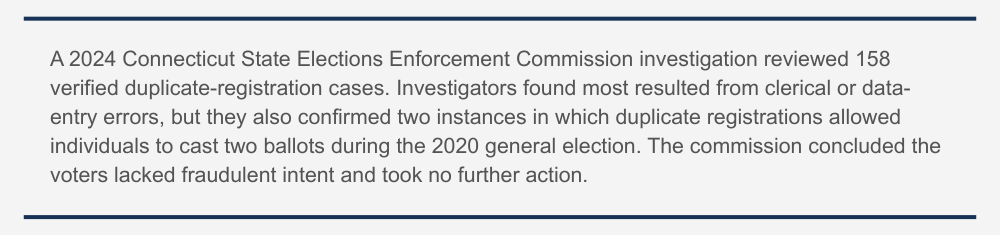
If there is any fault or blame to be apportioned when legally registered individuals are sent two ballots, it lies squarely at the feet of Colorado’s Secretary of State. If the appropriate checks and balances were in place, NO Coloradan should ever be registered twice nor should anyone ever be able to cast two votes in a single federal election.
Some registrations looked to me like slam dunk duplications although when I highlighted several to the appropriate county clerk’s office, they explained that where there was a one-to-one match, those records could be easily and speedily merged.
If there were differences in the last four digits of a Social Security number or date of birth between the two records, nothing could be done unless the registrant responded to requests to clarify the correct information.
If the registrant fails or refuses to cooperate with the county clerk’s office to confirm the correct information, they will continue receiving two sets of ballots each election cycle.
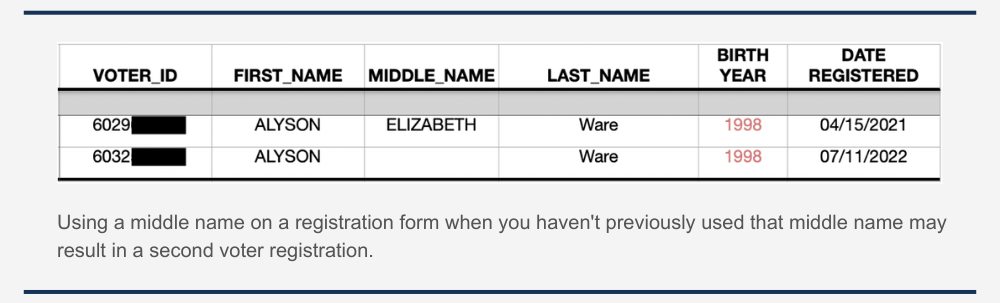
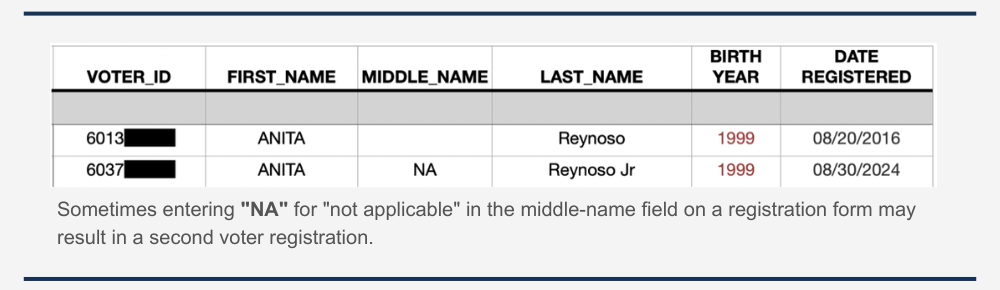
Some observed examples of apparently duplicated voter registrations:
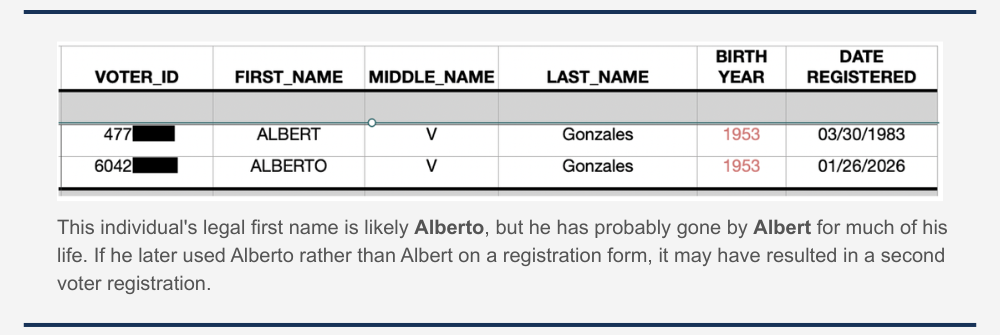
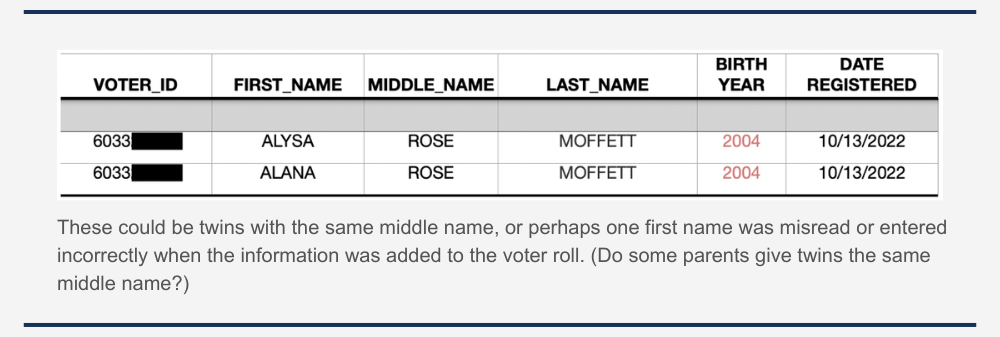
Rocky Mountain Voice redacted portions of the Colorado voter identification numbers shown below for privacy. RMV verified that each paired record contains a different voter identification number. Names, birth years and registration dates are drawn from Colorado’s public voter roll.
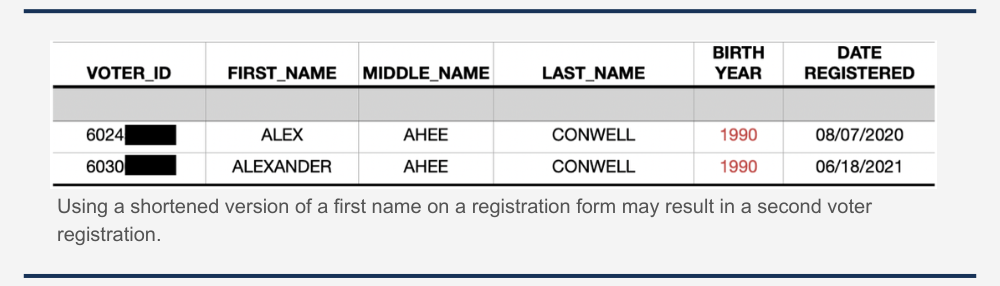
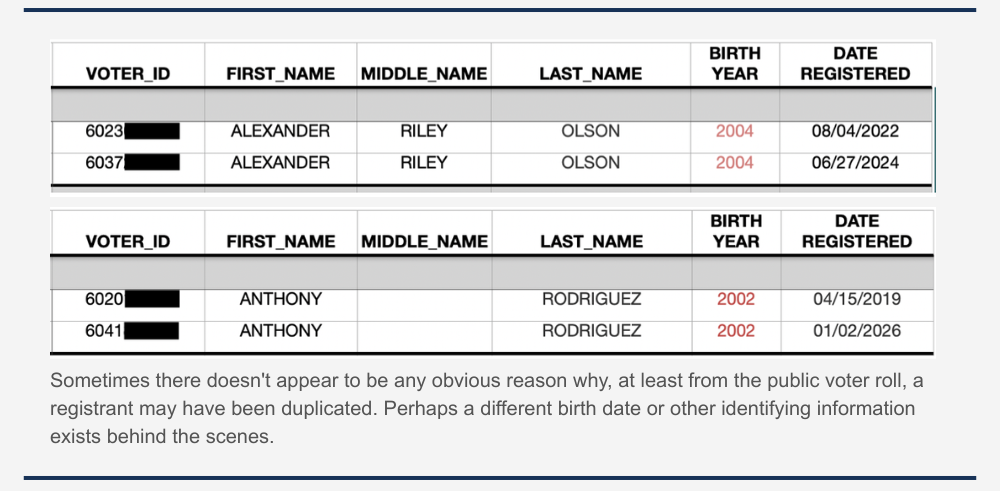
Some registrations appeared to be duplicates even though I couldn’t find any obvious explanation in the public voter roll.
Several other pairs shared addresses and birth years but contained name differences that could indicate either duplicate records or different individuals:
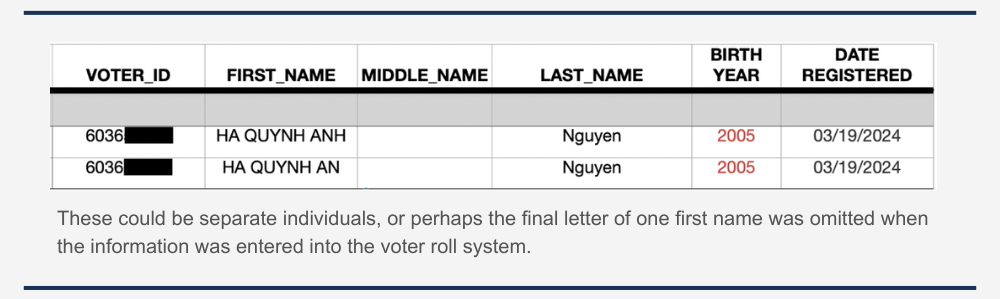
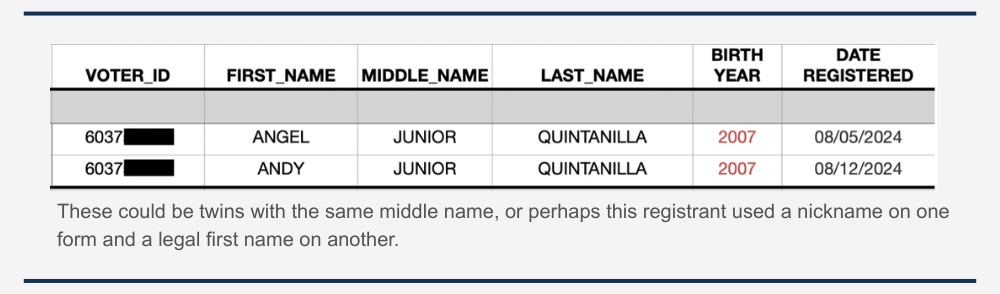
Would it really be so difficult for someone to check the address of a new registrant before physically adding them to the Colorado voter roll to see if anyone with a similar or identical name is already registered there?
Once someone has been added to the Colorado voter roll, even if the record was created in error or did not correspond to an actual eligible registrant, it is incredibly hard to remove. Common sense is definitely NOT a flower that grows in the Colorado Secretary of State’s garden.
Mike O’Donnell is a small business advocate, nonprofit executive and economic development leader based in Kirk, Colorado. He currently serves as Executive Director of Prairie Rose Development Corp., a mission-driven lender supporting underserved entrepreneurs across the state.
Editor’s note: This is Part 5 of a six-part guest commentary series examining Colorado’s voter registration system and voter roll through the author’s review of publicly available records and other cited sources. Read Part 1: Getting on is the easy part, Part 2: Getting off isn’t so easy, Part 3: Where the ballots go and Part 4: Following the ballot. Coming next: Part 6, the concluding installment of Mike O’Donnell’s series. Opinions expressed in commentary pieces are those of the author and do not necessarily reflect the views of Rocky Mountain Voice, but we support the constitutional right of authors to express those opinions.