
By Shaina Cole | Contributing Writer, Rocky Mountain Voice
Before Lorena García was a Colorado state representative, the organization she runs had collected about $13,000 from the state of Colorado in the five years before she filled the vacancy, according to state payment records.
That changed when she joined the legislature.
The Colorado Statewide Parent Coalition (CSPC) was founded in 1980 by Richard Garcia, Lorena García’s father, who ran it as executive director through 2017, according to the organization’s IRS filings. Lorena García took over as executive director in 2018.
Since García was appointed to the Colorado House in January 2023, the nonprofit she leads has received $6.64 million in state payments. That is 99.8 percent of every dollar state payment records show the organization collecting from Colorado taxpayers since 2018.
The payments to her nonprofit organization have drawn public scrutiny over the past year. Questions have been further raised about payments to her family through CSPC.
While that money was flowing in, the organization’s paid lobbyist was pushing bills García herself was authoring on the House floor.
From $13,000 to $6.6 million
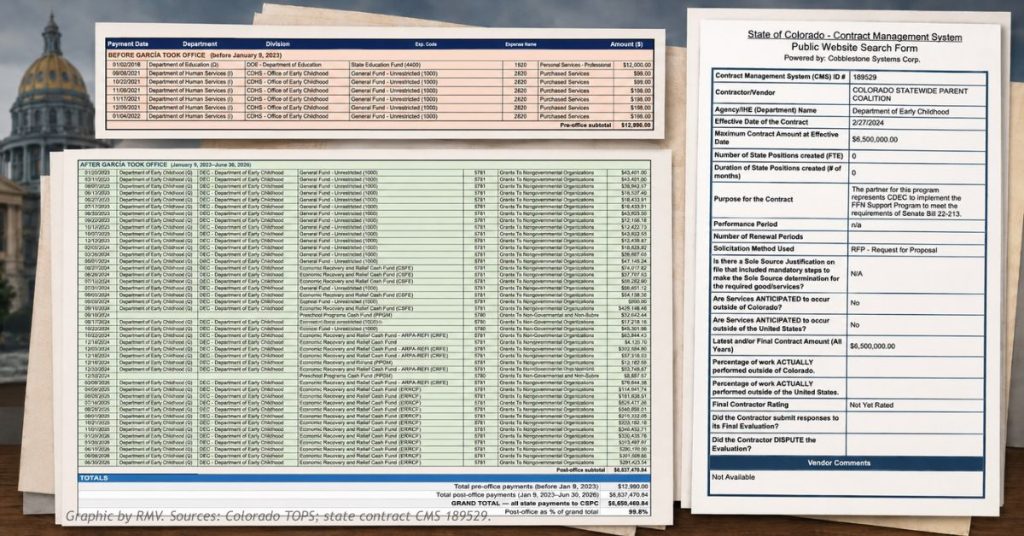
According to a state payment spreadsheet compiled by Cory Gaines of Complete Colorado from TOPS data and covering payments through March 2025, CSPC collected $12,990 from the state before García took office. That breaks down to a $12,000 payment in 2018, five payments totaling $792 in 2021 and one payment of $198 in 2022.

State payments to the Colorado Statewide Parent Coalition before Rep. Lorena García took office, January 2018–January 2022. Source: Colorado TOPS data compiled by Cory Gaines, Complete Colorado, July 2, 2025; independently verified by RMV.
In June 2022, Gov. Jared Polis signed Senate Bill 22-213, which set aside $7.5 million in federal pandemic relief funds for a new program to train and support informal child care providers: the grandparents, neighbors, and family members who watch children outside of licensed facilities.
Seven months later, she was appointed by a vacancy committee to the HD-35 seat, taking office January 9, 2023.
According to a state payment spreadsheet published by Complete Colorado and RMV’s own review of state payment records, in 2023, her first year in office, CSPC received $316,598. By 2024 that figure had grown to more than $1.4 million. In 2025 it reached $2.8 million. Through the first six months of 2026 alone, the state has paid CSPC more than $2 million.
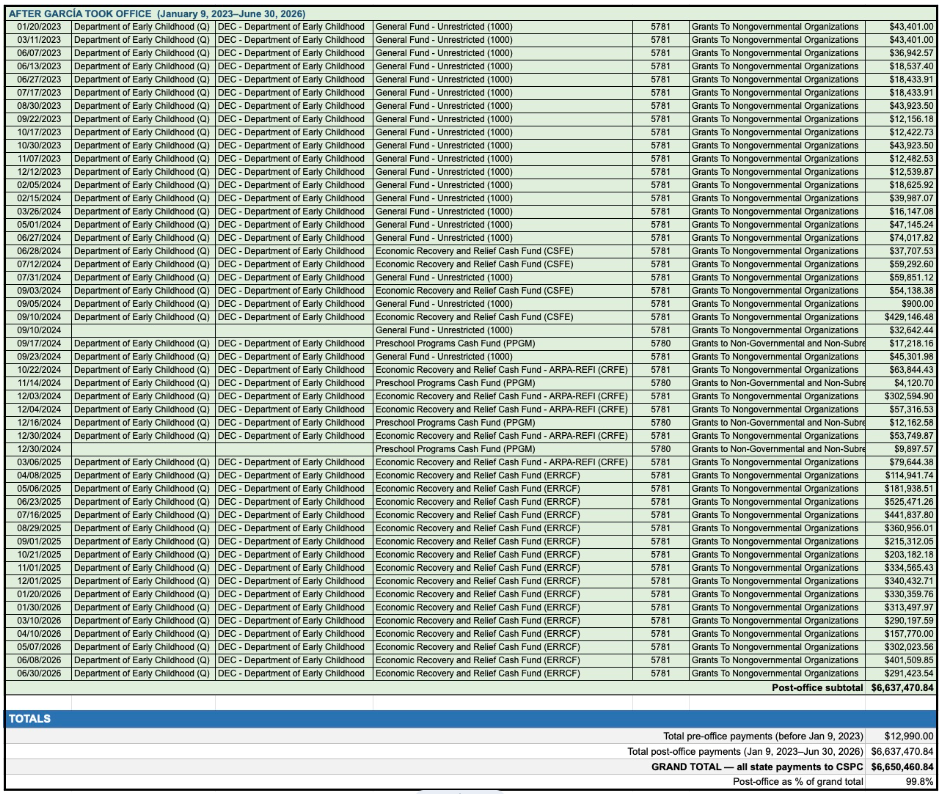
State payments to the Colorado Statewide Parent Coalition after Rep. Lorena García took office, January 2023–June 2026. Sources: Colorado TOPS data compiled by Cory Gaines, Complete Colorado, July 2, 2025 (through March 2025), independently verified by RMV; RMV independent TOPS portal review (April 2025–June 2026).
All of it flows through the Colorado Department of Early Childhood, the agency whose programs and authority García, as a member of the House Finance Committee, helps shape through legislation.
CSPC applied for the FFN (Family, Friend and Neighbor) contract through a competitive Request for Proposal process and won it, according to state contract records. The Colorado Department of Early Childhood’s $6.5 million contract with CSPC took effect on March 26, 2024 — 14 months after García took office.
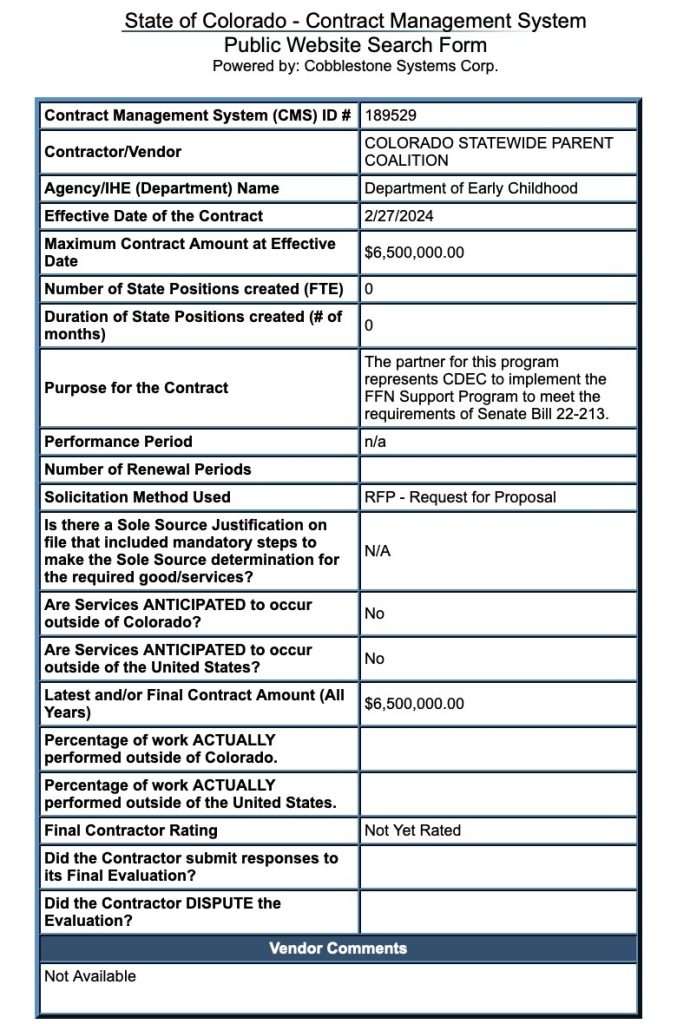
The Colorado State Contract Management System record for CSPC’s $6.5 million contract with the Colorado Department of Early Childhood, as it appeared when RMV reported this story. CDEC told RMV the February 27, 2024 date was a placeholder entered when the record was created, and that the contract was executed March 26, 2024. The record still displayed February 27, 2024 as of July 24, 2026. The contract implements the Family, Friend and Neighbor Support Program under Senate Bill 22-213. Solicitation method: Request for Proposal. Source: Colorado State Contract Management System, CMS ID 189529.
García told RMV, “The $6.5 million was used to re-grant to 24 other organizations who serve the FFN community as well as support CSPC’s Evidence-based PASO training program.”
CSPC’s independent auditors identified a material weakness in the organization’s internal controls in 2024. Auditors found that advances paid to subgrantees and related expenses were not properly reflected in the organization’s financial records — the same year CSPC was re-granting state and federal funds to 24 subgrantees. The audit found no questioned costs and no noncompliance with grant requirements.
Who benefits
García drew $132,000 in 2024 from CSPC, according to the organization’s IRS filings.
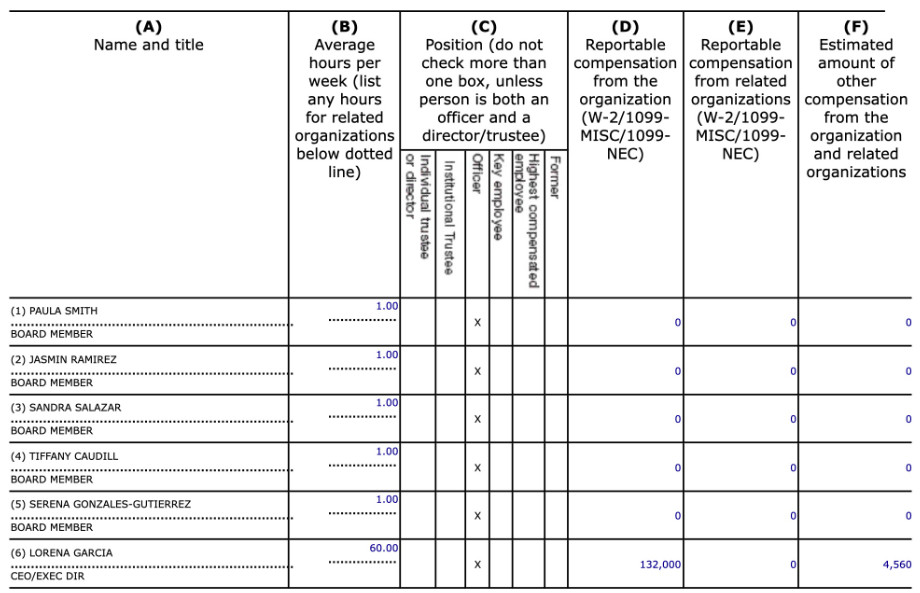
Compensation disclosed in CSPC’s IRS Form 990 for fiscal year 2024, showing Lorena García listed as “CEO/Exec Dir” with reportable compensation of $132,000. Source: CSPC Form 990, FY2024, ProPublica Nonprofit Explorer.
Her parents appear in the organization’s IRS filings as well. Schedule L of CSPC’s Form 990, which nonprofits must use to disclose transactions with related parties, shows CSPC paid her father, identified as “FATHER TO CEO,” $45,000 in fiscal year 2023 and $55,250 in fiscal year 2024.
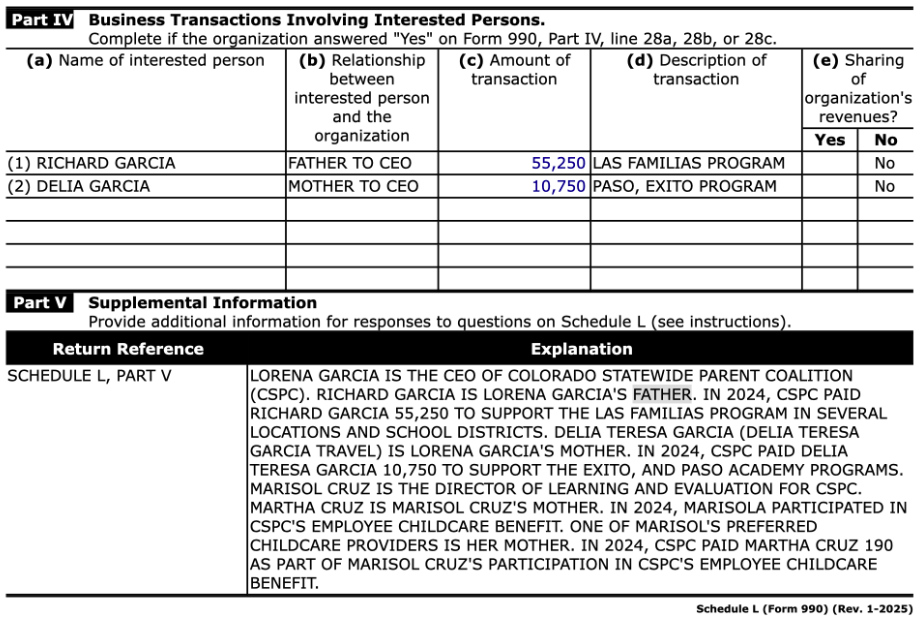
Schedule L of CSPC’s Form 990 for fiscal year 2024, disclosing transactions with related parties. The supplemental explanation states: “Lorena Garcia is the CEO of Colorado Statewide Parent Coalition (CSPC). Richard Garcia is Lorena Garcia’s Father.” CSPC paid Richard Garcia $55,250 for the Las Familias Program and Delia Teresa Garcia $10,750 for the PASO and Exito programs. Source: CSPC Form 990, Schedule L, FY2024, ProPublica Nonprofit Explorer.
García said the payments were not state money. “Richard was contracted to facilitate the Las Familias Program because he created this program,” she wrote. “His contract is through a grant with the National Center for Families Learning which is a federal DOE grant CFDA 84.310A.” CSPC is a named partner in that federal grant according to an announcement from the National Center for Families Learning.
The same Schedule L shows CSPC paid her mother, identified as “MOTHER TO CEO,” $15,000 in FY2023 and $10,750 in FY2024 for what García described as work on the PASO curriculum.
The lobbying and the bills she authored
CSPC reported spending $48,000 in 2023 and $16,000 in 2024, according to its IRS filings.
State lobbyist disclosure records identify the firm as Policy Matters LLC — and show what that bought. Of the bills that Policy Matters lobbied on behalf of CSPC, several were sponsored or co-sponsored by García.
In 2024, García prime-sponsored HB24-1223, an overhaul of the state’s child care assistance program, and HB24-1312, a tax credit for child care workers. She also co-sponsored HB24-1311, a family affordability tax credit. Policy Matters lobbied in support of all three on CSPC’s behalf.
In 2025, the firm supported HB25-1296, a tax expenditure bill that García prime-sponsored.
In the 2026 session, CSPC’s lobbyist did not support any bills García authored, according to Secretary of State disclosure records.
No Colorado law prohibits a legislator from running a nonprofit that receives state money, hiring a lobbyist, or sponsoring and voting on bills that lobbyist supports. García is CEO of CSPC, the organization paying the lobbyist, while simultaneously serving as the legislator authoring and voting on those same bills.
Whether the situation rises to a legal conflict of interest under C.R.S. 24-18-107 has not been formally determined.
The rules she applied — and didn’t
The House does have a rule. House Rule 21(c) requires a member with an immediate personal or financial interest in a bill to disclose it to the House and not vote on it.
In 2026, García invoked that rule twice.
She recused on HB26-1004, which extended a child care contribution tax credit, according to the 2026 House Journal.
She told RMV, “I recused myself because my organization receives funds from the CCCTC fund held at the Denver Foundation. … I believed that even if I don’t personally benefit, the organization I run does.”
On HB26-1274, a bill allowing nonprofits to receive advance payments on state grants, García was originally listed as a co-prime sponsor and voted yes on its passage to the Senate.
Republican Sen. Byron Pelton introduced a Senate amendment providing that an agency “shall not authorize advance payment to a grantee pursuant to this section if a member of the general assembly is an employee, officer, director, contractor, or paid consultant of the grantee.”
The amendment passed in the Senate. When the bill came back to the House, the Speaker removed García from the bill entirely at her own request, and she recused from the vote.
On the House floor, García said she understood that legislators get attacked for their votes and beliefs, but stated, “What the Senate did was a direct and personal attack on me.”
But she voted on four other child care bills without recusing — HB26-1260, HB24-1223, HB24-1312, and SB25-004 — all involving programs administered by the same agency that holds CSPC’s $6.5 million contract, with no recusal recorded in the House Journal for any of them.
Asked why, she drew a narrower line. “These bills do not result in funds coming to the organization in any way,” she wrote.
Her first answer said she recuses when the organization she runs benefits. Her second said she only recuses when funds flow directly to CSPC.
Colorado’s ethics statute leaves room for that line. C.R.S. 24-18-107 says an interest situation “does not arise from legislation affecting the entire membership of a class.” Legislative Legal Services teaches the rule with a landlord: a lawmaker who owns rental property may vote on tenant bills, because the class is every rental property owner in the state.
García made that argument herself.
“I wonder what landlords should do when they vote on bills dealing with tenants and renters rights?” she wrote. “…or anyone who runs a business that benefits directly from policy that benefits their industry like agriculture, or oil and gas…”
The exception reaches a bill that funds child care organizations across Colorado. It does not reach a bill that sends money to CSPC.
It does not reach HB25-1296 either. García prime-sponsored the bill in 2025.
Section 9 of it extended the child care contribution tax credit — the same child care tax credit that she recused herself from a year later, when its continuation, HB26-1004, came to a vote. She did not address the gap when RMV asked.
García also pointed to another legislator. “…have you talked to Sen. Scott Bright about his votes on childcare policy?” she wrote.
Bright, a Republican who represents Senate District 13 in Weld and Adams counties, “runs multiple child care centers,” García wrote. “He has sponsored multiple bills that would have led to direct funds going to his center.” Asked for specifics, García named no bills.
Her defense
On the House floor, García defended her record. “I’ve never hidden the fact that I have a job outside of this building, that I run a nonprofit organization,” she said. “I’ve never hidden the fact that we hold a state grant.”
She told RMV her salary comes from private philanthropy, not state contracts. “My salary is paid for through private donations and private philanthropy. I do not get paid by any gov’t contract.”
No Colorado law prohibits any of it.
García has applied the recusal standard by two different standards across bills touching the same agency that holds CSPC’s contract. Separately, her organization’s paid lobbyist was supporting bills she authored across multiple sessions.
The HB26-1274 debate prompted further action.
Pelton told Complete Colorado he plans to introduce legislation next year prohibiting any legislator from taking compensation from a nonprofit. Thirteen Democrat senators, several with nonprofit ties of their own, voted against his amendment.
García ran unopposed in the June 30 Democrat primary and is on the November ballot in House District 35, according to unofficial results from the Colorado Secretary of State.
Whether the legislature closes that gap for nonprofit-employed legislators like García remains to be seen. So does whether a separate bill is needed to address the broader question she raised — legislators who own businesses that benefit from policy they vote on. Both wait for the 2027 session.
Editor’s note (July 24, 2026): This article originally reported that CSPC’s contract with the Colorado Department of Early Childhood took effect February 27, 2024, the effective date listed in the Colorado State Contract Management System. After an inquiry from RMV, CDEC said that date was a placeholder entered when the record was created and that the contract was executed March 26, 2024. The department has updated its Family, Friend and Neighbor Advisory Council and Training Programs webpage to reflect a late March 2024 signing. CDEC also said it corrected the Contract Management System record, which still displayed February 27, 2024 as of July 24, 2026. This article has been updated.