
By Jen Schumann | Rocky Mountain Voice
Before Colorado’s June 30 primary results become official, counties across Colorado must complete one of the final steps required by state election law: a post-election risk-limiting audit.
Mesa County completed its audit Tuesday.
“Mesa pulled 115 with zero discrepancies,” Mesa County Clerk Bobbie Gross told RMV.
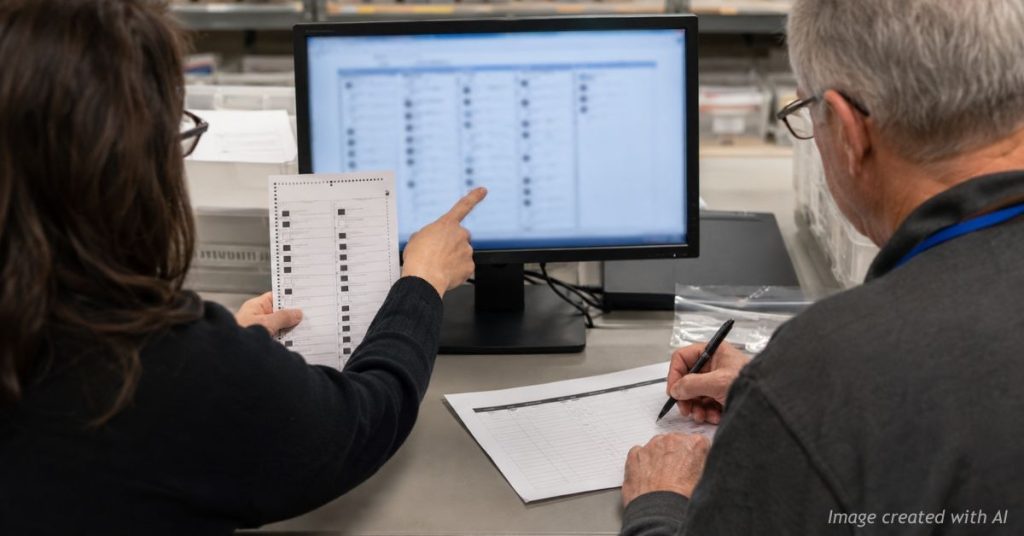
The audit compares randomly selected paper ballot cards with how the voting system recorded the votes on them. It does not review every part of the election.
What the audit checks
Colorado law requires a risk-limiting audit after every primary, general, coordinated, recall and congressional vacancy election. State law describes it as a statistical audit intended to reduce the risk of certifying an incorrect election outcome.
Before the audit begins, each county prepares two records.
A ballot manifest identifies where ballots are stored. A Cast Vote Record, or CVR, shows how the county’s voting system interpreted each ballot during tabulation.
Colorado’s audit rules use the term “ballot card” because a single voter’s ballot may span more than one physical card, even though election judges retrieve physical ballots during the audit.
Counties verify those records, generate hash values for the uploaded files and submit them to the Secretary of State before auditing begins. The Secretary of State publishes each county’s upload status and file hashes through the Audit Center for public review.
Bipartisan audit boards compare selected paper ballots with the voting system’s recorded interpretation of those ballots.
If the audit meets the state’s 3 percent risk limit, counties move another step toward certification. If it does not, additional ballots are selected and the audit continues until the state’s required risk limit is met or, if necessary, a full hand count is conducted.
How ballots are selected
On July 6, the Secretary of State selected this year’s target contests using factors outlined in Colorado’s election rules.
At a public meeting Monday held by the Colorado Secretary of State, 20 ten-sided dice were rolled to generate a 20-digit random seed: 49006417086137856424. The seed was entered into the state’s open-source audit software, which produced the list of ballots each county was directed to retrieve. Because the seed is public, anyone using the same software can reproduce the selection.
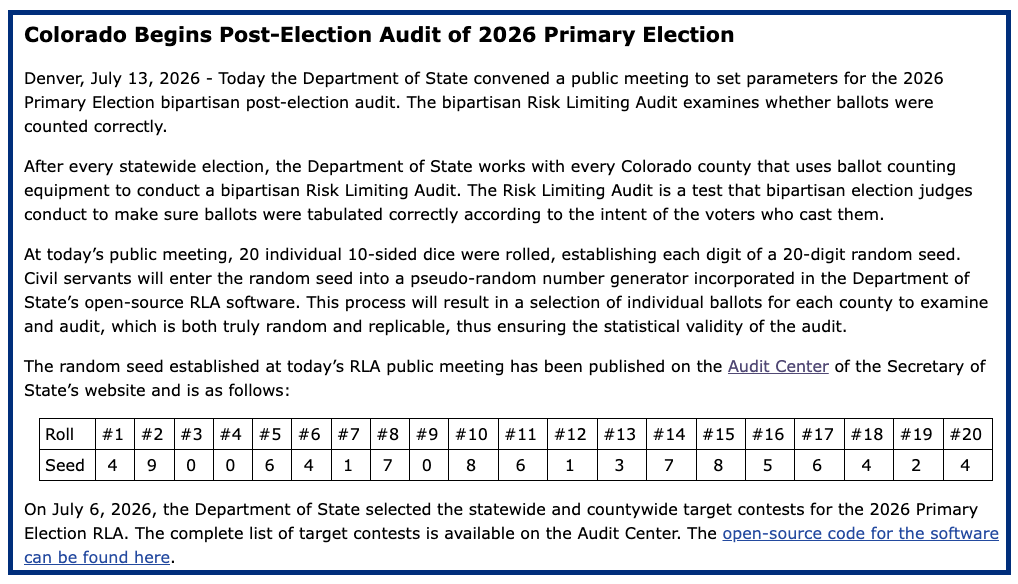
The random seed from the July 13 public meeting, one digit per die roll. Source: Colorado Secretary of State
Why the sample sizes seem small
One of the most common questions about Colorado’s audit is why counties examine only a relatively small number of ballots.
The audit is not based on reviewing a fixed percentage of ballots cast.
Instead, the initial sample is driven largely by how close the selected contest was. Wider margins generally require smaller samples, while closer contests require larger ones.
The Secretary of State’s planning spreadsheet estimated 118 ballot cards for the statewide Democrat primary for U.S. Senate, one of the three contests Mesa audited. Gross said Mesa ultimately examined 115 physical ballots.
Denver’s Republican primary for governor, a much closer race, carried an estimated sample of 312 ballot cards, while a Democrat House District 19 primary in Weld County carried an estimated 281.
Those planning figures are estimates, not limits. If the audit does not satisfy Colorado’s required 3 percent risk limit, additional ballots are selected for review.
Why counties are auditing different races
Colorado’s risk-limiting audit includes 63 of the state’s 64 counties. The lone exception is San Juan County, Colorado’s smallest county by population, which hand-counts every ballot instead of using vote-counting machines, Rocky Mountain PBS reported. Because the audit is a test of voting system tabulation, a county without one doesn’t participate.
The remaining counties are not all reviewing the same contests.
The Secretary of State selected statewide, legislative and county contests based on what appeared on each county’s ballot. Colorado’s audit rules provide that the target contest with the closest diluted margin determines how many ballot cards a county must examine.
Gross said Mesa audited three contests: the Democrat primary for governor, the Republican primary for attorney general and the Democrat primary for U.S. Senate.
“We audited Gov D, AG R and US Senate D although the whole ballot is audited and we had zero discrepancies,” Gross said.
Under Colorado’s comparison-audit rules, the selected contests determine the statistical test. Once a ballot card is selected, however, election judges record the voter markings for every contest appearing on that card.
What the audit does not examine
The risk-limiting audit focuses on vote tabulation. It is not a review of voter eligibility, voter registration, signature verification, citizenship, residency or whether a ballot was legally accepted into the count.
Those issues are handled elsewhere in Colorado’s election process.
It also does not review ballots that were rejected or never counted.
An audit that satisfies Colorado’s statistical standard supports a limited conclusion under state law: that the sampled paper ballots provide the statistical evidence required for the reported outcome in the selected contests. It is not a finding that every part of the election was conducted without error.
The Secretary of State says the audit “examines whether ballots were counted correctly” and that statewide risk-limiting audits since 2017 have not identified discrepancies caused by voting systems failing to operate as intended.
Before results become official
Mesa County has completed its county audit work, but the statewide process continues.
County audit reports are due to the Secretary of State by 5 p.m. on July 21, giving the state time to review them before county canvass boards meet by July 22 to certify results. Counties cannot certify until the Secretary of State authorizes them under Colorado’s audit rules.
If the audit meets the state’s 3 percent risk limit, counties move toward certification. If it does not, additional ballots are selected. If necessary, the audit continues through additional rounds and ultimately a full hand count before results are certified.