
By Booker Lightman | Guest Commentary, Rocky Mountain Voice
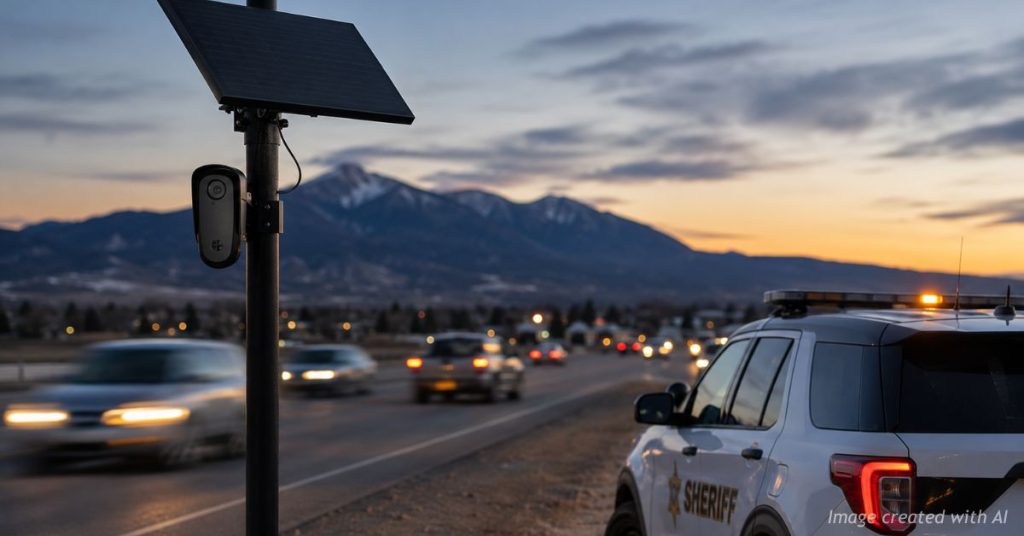
Police departments across Colorado have installed AI-powered Flock cameras to help them catch criminals. Not everyone is grateful. The fiercest opposition has come from the political Left, often driven by fears the cameras will aid ICE. These concerns led Denver to drop its contract with Flock, while a bill in the state legislature that would have required warrants for most searches of license plate data died in April after pushback from law enforcement.
Some on the Right have joined the anti-Flock crusade, concerned about the cameras’ supposed threat to privacy.
Flock critics often claim the cameras are unnecessary and that the proper solution to crime is to hire more police officers. The people best placed to know, Republican sheriffs in Colorado’s large red counties, do not agree.
Darren Weekly in Douglas County, Joseph Roybal in El Paso County, and Todd Rowell in Mesa County have all stood behind the Flock system. Consider what happened in El Paso County last September.
A Flock camera flagged a car tied to a 41-year-old wanted for attempted murder, who was tracked to a Walmart parking lot and arrested without incident. This was only possible due to Flock’s ability to search a database of license plates; it’s highly unlikely that an officer entering data manually would have been in the right place at the right time to catch him.
Skeptics like to point out that police controlled crime for generations without any of this technology, so why should they need it now?
But this ignores that criminals themselves have become more technologically sophisticated. Criminals in 1960 did not carry machines in their pockets that they could use to instantly coordinate with nationwide crime networks. They did not have access to online marketplaces to fence stolen goods. Technologically shackling our police forces out of a misplaced sense of nostalgia will only empower the criminal element.
The critics are not wrong that Flock cameras are a mass surveillance system. But it is worth asking what, exactly, is being surveilled: the public roads. There has never been a right to travel the public roads anonymously. We settled that question more than a century ago, when states began requiring every vehicle to display a license plate. If you believe the state has no business knowing which cars travel its roads, your quarrel is not with Flock, it is with the license plate itself, and I’ve yet to hear an anti-Flock activist demand its abolition.
It has often been said that the price of liberty is eternal vigilance. The man who accepts anything so long as a man with a badge says it’s necessary is abdicating his civic duty. So too is the man who is unthinkingly distrustful of government, who refuses to listen to arguments in favor of Flock cameras, who pats himself on the back for not “falling for it.”
Both have adopted a worldview that asks nothing of them, that trades critical thinking for a predetermined conclusion. The latter may fancy himself more sophisticated than the former, but his ideas are every bit as vapid.
If you want to see where the anti-Flock ideology leads, look to Cambridge, Massachusetts. In May, the city council deactivated its ShotSpotter gunshot detection system, a different technology than Flock but a target of the same political attacks. On the Fourth of July, a city worker named Xavier Bautista was shot and killed in a park where ShotSpotter coverage had just been switched off. No sensors alerted police. He lay in the street for an hour before a pedestrian found him and called 911.
No arrests have been made in connection with the shooting.
While we cannot be sure that ShotSpotter would have made a difference, the victim’s family and the wider community are justifiably angry.
A Colorado Republican Party that turned against Flock would not merely compromise the safety of its own voters; it would abandon one of its strongest issues at the very moment the public has soured on the Democrats’ approach to crime.
Booker Lightman is a Highlands Ranch resident active in the Douglas County GOP.
Editor’s note: Opinions expressed in commentary pieces are those of the author and do not necessarily reflect the opinions of the management of the Rocky Mountain Voice, but even so we support the constitutional right of the author to express those opinions.