
By Jen Schumann | Rocky Mountain Voice
Colorado joined 24 other states and the District of Columbia on Thursday in suing the Trump administration over new rules that withhold a fifth of the state’s counterterrorism grant money unless Colorado shows it meets five federal election requirements.
One of the five requirements asks Colorado to plan a change state rules already require.
The lawsuit was filed in U.S. District Court in Rhode Island, where judges ruled against DHS in two similar grant disputes last year. One of those decisions is on appeal.
Colorado sued DHS, FEMA, Homeland Security Secretary Markwayne Mullin and Robert J. Fenton, the senior official performing the duties of FEMA administrator.
“We’re suing again, and we’ll win again, because the administration cannot force states to change how they manage elections in exchange for critical security funding mandated by Congress,” Attorney General Phil Weiser said in a statement.
What the rules require
FEMA attached five election conditions to the 2026 Homeland Security Grant Program, which pays for terrorism preparedness, cybersecurity and emergency response.
Two of the five assign duties to “the State’s chief election official.” Under state law, that is Secretary of State Jena Griswold. But the Homeland Security Grant Program is administered through the Colorado Division of Homeland Security and Emergency Management, part of the Department of Public Safety.
One agency applies for the money. If Colorado accepts an award, the Secretary of State is the one directed to act.
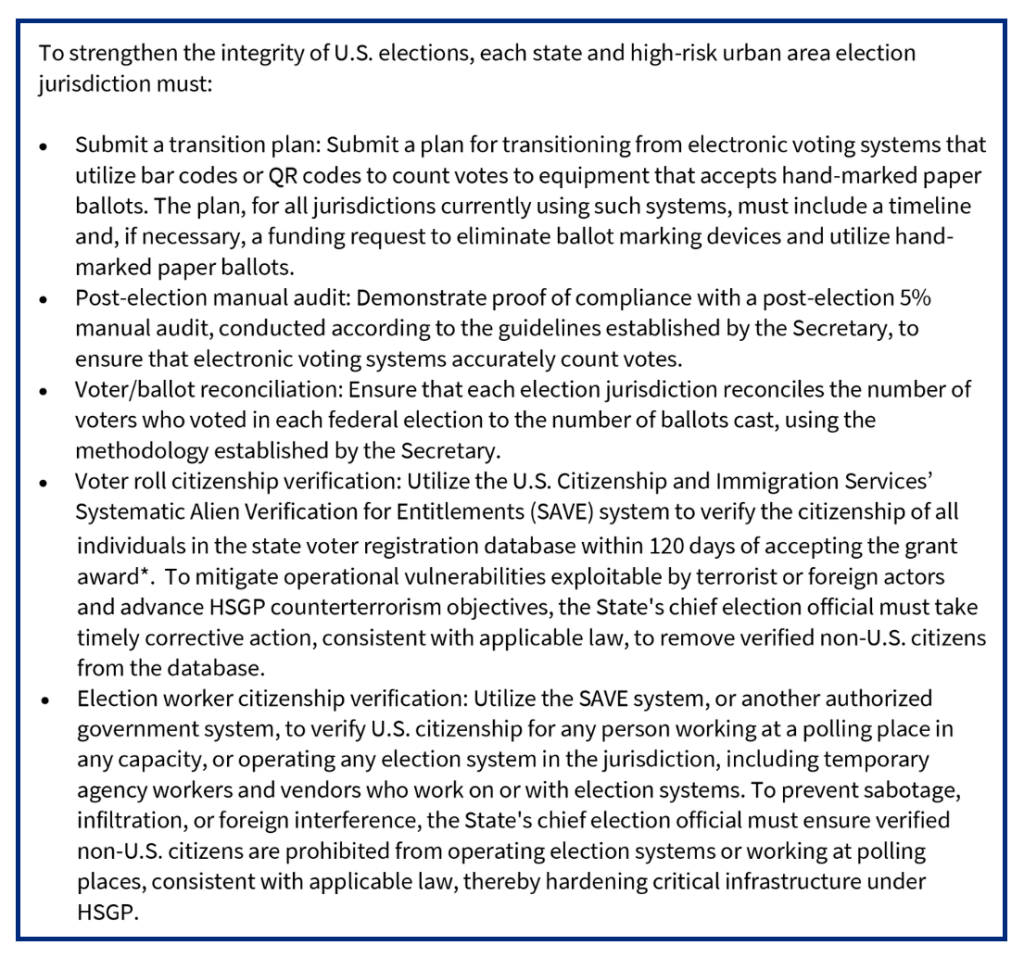
The five election-security conditions FEMA attached to the 2026 Homeland Security Grant Program, from pages 15 and 16 of the notice of funding opportunity.
FEMA will withhold 20 percent of each state’s award until the state proves it has complied and the department verifies that proof. A separate requirement directs states and urban areas to spend at least 3 percent of their state homeland security and urban area funds on election security. The two do not offset each other.
DHS announced the conditions July 10.
“Election security is national security and protecting the Nation’s critical infrastructure is a top priority,” Mullin said in the announcement. “Under President Trump’s leadership, we are taking decisive action to protect election systems from threats like foreign interference, insider threats, and cyberattacks. These new requirements for homeland security grant recipients will preserve election integrity and ensure that Americans can trust the result.”
DHS cited foreign interference, insider threats and cyberattacks. Six days later, Trump released declassified intelligence about foreign collection of American voter data. Two of those documents mention Colorado: one describes a Chinese cyber actor downloading publicly available Colorado voter registration data from commercial websites in January 2022, and another describes an actor who had purchased 2020 voter data covering cities in seven states, Colorado among them. Neither alleges any failure by Colorado election officials.
Colorado already requires what the first condition asks for
The federal condition asks states to submit a plan, with a timeline, for moving away from vote counting by QR code or bar code.
Colorado requires the outcome already. The Secretary of State’s conditions of use for the Dominion Democracy Suite 5.17 voting system, issued Sept. 11, 2025, state: “Counties may not use the QR code ballots. All counties must configure their systems for ICX ballot marking devices to print uniform ballots during ballot programming.”
That policy traces back to a September 2019 announcement from Secretary of State Jena Griswold’s office.
“Colorado will be the first state to require voting systems to tabulate all ballots using only human-verifiable information and not QR codes,” the announcement said. “Once fully implemented, all ballots voted in Colorado will be tabulated using the marked ovals on the ballot rather than information from a QR code.”
Colorado mails ballots to every active voter. Those who vote in person can use a ballot-marking device that prints a paper ballot for review before it is cast.
The audit condition is a closer call. Colorado law makes risk-limiting audits the default, checking a statistically determined sample of ballots against machine tallies. A 2024 amendment added a fallback: if the secretary of state determines a risk-limiting audit cannot be performed, the secretary must initiate a manual random audit conducted by each county, covering not less than 5 percent of the voting devices used in that county. Where central count equipment is in use, the audit covers a percentage of ballots set by the secretary’s rules instead.
So Colorado has a 5 percent standard on the books. It counts devices rather than ballots in most cases, and it applies only when a risk-limiting audit is not possible.
Guidelines DHS has not published
The attorneys general argue two of the conditions cannot be complied with as written.
The audit must follow “the guidelines established by the Secretary” of homeland security. The reconciliation must use “the methodology established by the Secretary.” Neither had been adopted or made available to the states when the suit was filed, according to the complaint.
The states say they cannot knowingly accept conditions that point to instructions DHS has not given them. Conditions on federal money have to be clear enough that a state can weigh them before saying yes.
The complaint lists 12 claims. The states say Congress never gave DHS and FEMA the authority to impose the conditions, that the agencies never adequately explained them, and that election administration sits too far from the counterterrorism purpose of the money. The legal grounds are the Administrative Procedure Act and the Constitution’s Spending Clause.
Election rules account for only part of the lawsuit. The complaint also targets immigration conditions a federal court struck down last year, and new provisions that would let FEMA cancel grants for convenience or because agency priorities shifted after an award was made.
The money
FEMA’s funding notice allocates Colorado $4,362,750 under the State Homeland Security Program, $5,790,761 for the Denver-Aurora-Lakewood urban area and $2,757,605 for Colorado Springs. The state receives nothing under Operation Stonegarden, the border security component. That comes to $12,911,116.
Weiser’s release put Colorado’s annual homeland security funding at nearly $19 million. RMV asked how that figure was reached.
“We include FEMA Emergency Management Performance Grant Program funds in the total,” said Lawrence Pacheco, chief communications officer for the attorney general’s office. “Funds allocated to Colorado for FY2026 is $6,052,730. Total allocated for Colorado is $18,927,846.”
Pacheco declined further comment.
Measured against Colorado’s homeland security allocation, the 20 percent holdback comes to roughly $2.6 million. The election holdback does not apply to the emergency management grant, though the lawsuit challenges other conditions attached to that program.
Colorado’s homeland security money has historically gone to sheriffs’ offices, county governments, small towns and school districts. FY2025 awards included the Larimer and Mesa county sheriffs, Summit County, the town of Johnstown and Thompson School District.
What the state has not said
Colorado has not said which conditions it believes it cannot meet.
RMV asked the Secretary of State’s Office which requirements Colorado cannot satisfy under current law, whether the state already complies with any of them, whether its risk-limiting audit meets the federal audit condition, whether current equipment already satisfies the bar-code condition, whether running every registrant through SAVE would conflict with state law or election procedures, and whether Colorado would comply or decline the money if the lawsuit fails. The office had not responded before publication.
The timing is tight. Federal applications close Friday. Colorado’s Division of Homeland Security and Emergency Management extended its deadline for local State Homeland Security Program applications to Aug. 5, citing the wildfires burning across the state.
FEMA expects to announce awards by Sept. 30.
The complaint asks the court to block the conditions before the money moves.