
By Shaina Cole | Contributing Writer, Rocky Mountain Voice
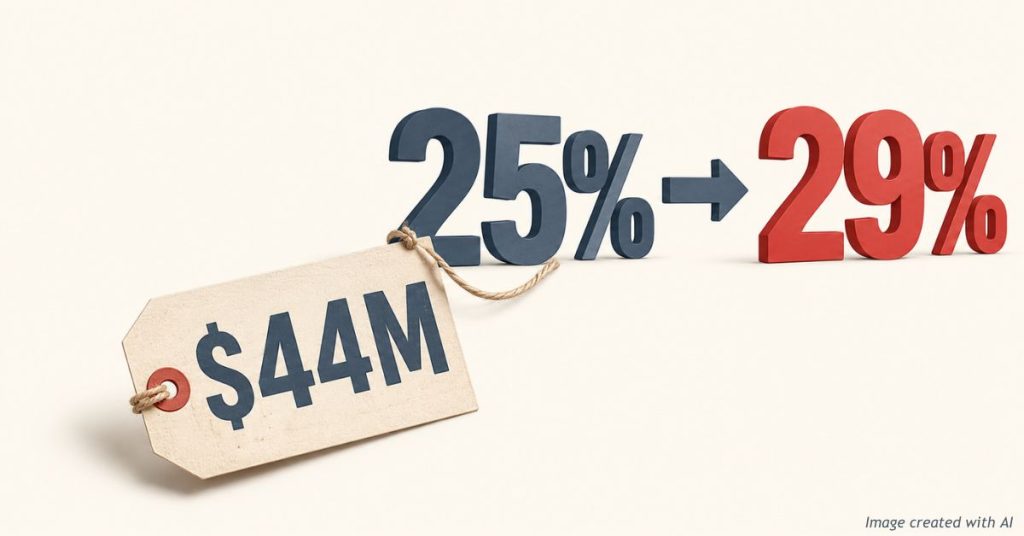
The question Denver voters will mark this November asks whether to raise Denver Public Schools taxes “up to $44 million.” That is the number on the ballot, the number in the district’s public materials, and the figure repeated in news coverage of the measure.
The $44 million is not a fixed cap on what the tax could raise in the years after.
Read the board’s resolution, adopted Aug. 13, along with the ballot question it certified, and the $44 million turns out to be an estimate for the first year.
What voters would also authorize is a permanent change to the ceiling on how much the district can collect through its operational overrides — a ceiling written as a share of the district’s total program funding, not as a dollar figure. The dollar amount it allows moves with that funding rather than holding at $44 million. And the percentage mechanism that sets it appears nowhere in the question.
What the ballot says, and what the resolution says
The ballot question tells voters the money is for “educational purposes, including, but not limited to” educator pay, career and technical education, and student mental health and special education. It sets the tax “up to $44 million in 2026 (for collection in 2027) and annually thereafter.”
The operative clause comes later in the same question. It sets the levy at a rate that, combined with the district’s existing overrides, “equals the amount permitted by Section 22-54-108(3)(b)(vi)” of state law.
That statute is where the real number lives. The board’s resolution states in the recitals that the district seeks to “authorize an increase of the District’s mill levy override limit from 25% of total program funding to 29% of total program funding.”
A 2024 state law, HB24-1448, raised the cap that districts may reach. This measure asks Denver voters to let the district climb to the new ceiling.
Because that ceiling is a percentage of total program funding rather than a fixed dollar amount, the sum it authorizes tracks that funding rather than holding at $44 million.
The $44 million is the increase created by moving the district’s operational override limit from 25 to 29 percent.
The district calculates its current maximum at about $288.9 million and the new maximum at about $332.9 million. The 29 percent ceiling is the roughly $332.9 million figure, not the $44 million.
It is not a cap on what the authority produces in a year when total program funding is higher. Those figures come from a district presentation to the board, reported by the Denver Gazette.
None of that percentage mechanism is in the question voters will read. They will see “up to $44 million.”
No expiration
The tax would not end on its own.
Section 5 of the resolution grants what it calls “a continuing authority to levy,” and spells out that “neither the partial exercise of the authority so conferred, nor any lapse of time, shall be considered as exhausting or limiting the full authority so conferred.”
The ballot question carries the same idea in four words: “and annually thereafter.”
This would be the district’s eighth override. Denver voters approved the previous seven, dating to 1988, and none of them expired either.
DPS spokesperson Bill Good told the Denver Gazette that all of the district’s overrides “are still in effect and will continue in perpetuity.”
The district collected $369.6 million from them last year. Most of that, about $267.5 million, came from six operational overrides that fall under the cap this measure would raise. A separate 2020 special-revenue override, which sits outside that cap, brought in the other $102.1 million.
One dollar in five goes to charter schools
The district’s own explanation of the measure lists where the $44 million would go. A $1,750 base raise for all staff accounts for $25.8 million. Student mental health and special education take $4.9 million. Career and technical education hubs take $4 million.
The last piece is $9.3 million, “set aside for the charter share per state statute,” in the district’s words.
State law requires districts to share override revenue with their charter schools. That is roughly a fifth of the total.
It is disclosed in the district’s frequently-asked-questions page. It is not in the ballot question. A voter reading only the question they mark would not know that about one dollar in five is routed to charters by law.
A tax question after the funding holdback hit zero
The request does not come in a lean year for Colorado schools.
In fiscal 2025, the state zeroed out the Budget Stabilization Factor, the mechanism that had held back roughly $10 billion from school funding since 2011, after lawmakers passed SB24-188. The state put about $5.6 billion into district programs that year, and local property-tax revenue climbed the following year.
DPS also has a real problem. Enrollment is falling.
The district reported a loss of about 1,200 students in its most recent count and roughly $18 million in lost annual revenue, cushioned to about $9 million for now by a three-year averaging rule, Good told the Denver Gazette.
District officials expect that loss to grow to around $70 million a year over the next four years as the averaging phases out. Funding follows students, and Denver’s are leaving.
The district frames the override as the way to hold pay and programs steady while that plays out.
Required format, and what it obscures
The $44 million lead-in is required. Colorado’s constitution dictates that a tax-increase ballot title must begin with the first — or, if phased in, final — full fiscal year’s dollar increase, the reason “up to $44 million” leads the question, while Denver’s proposed levy is tied to the statutory formula.
The point is not that DPS violated the required ballot format. It is that this question tells voters a single first-year dollar figure and leaves the permanent, self-adjusting mechanism to the statute it cites.
A Denver homeowner deciding how to vote will read “up to $44 million,” an estimated $71 a year on a median home, in the district’s figures. The resolution behind it authorizes a move to 29 percent of total program funding, with no end date. Roughly a fifth of the new $44 million is set aside for charters under state law, and the dollar ceiling moves with the district’s total program funding rather than staying at $44 million.
Voters can decide the schools are worth it. Seven times before, Denver’s have. The question is whether the ballot tells them what they are deciding.
The election is Nov. 3.