
By Shaina Cole | Contributing Writer, Rocky Mountain Voice
Kevin Flynn asked the question two different ways on two different days. What data does Denver collect or share now that it wouldn’t under this ordinance? By the time the committee voted, he had one narrow answer about collection and none about sharing.
“What are we doing today that under this ordinance we will no longer be doing?” the Southwest Denver councilman asked Monday, when the Sex and Gender Identity Protection Ordinance came before the Budget and Policy Committee for a briefing. “I’m having trouble understanding or visualizing it.”
He tried again Wednesday, when the same bill reached the Health and Safety Committee for a vote. He said he was “surprised to learn that we’re sharing this information with anybody or any other state,” and asked the sponsors for examples of what the city hands over now that it wouldn’t hand over later.
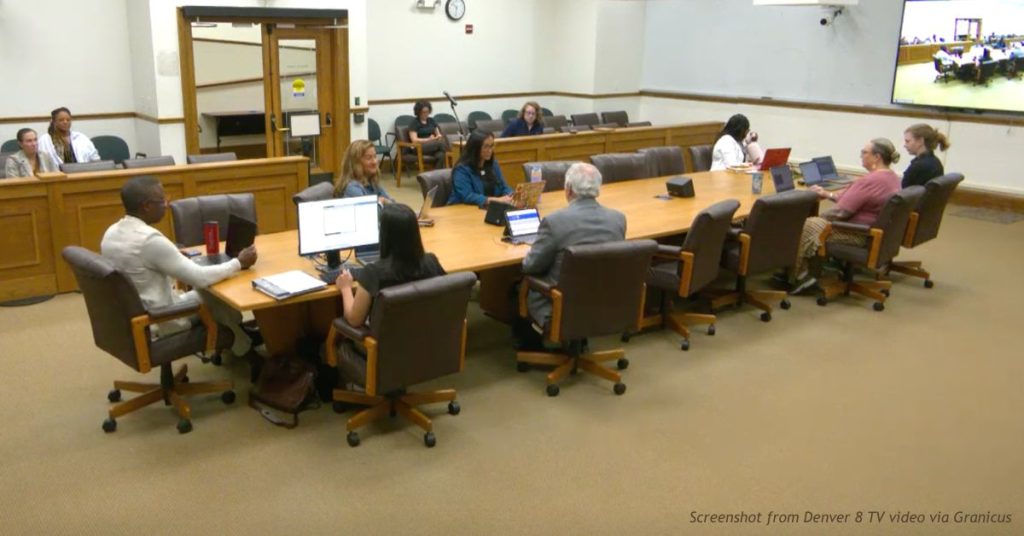
The committee approved the bill for filing, 5-0. Watson asked whether anyone needed a roll call. No one did, and the measure carried on a show of hands. Flynn was among the five ayes.
Council Bill 26-1305 restricts how Denver agencies collect, keep and share information about a person’s “actual or perceived” sex, sexual orientation, gender identity or gender expression. The text is not limited to transgender residents. It applies to any individual’s actual or perceived sex, sexual orientation, gender identity or gender expression.
But the bill’s sponsors, Stacie Gilmore and Shontel Lewis, have been explicit that the aim is to protect transgender residents. Sponsors said first reading is planned for Sept. 28 and second reading for Oct. 5, with the rule taking effect Jan. 1, 2027.
What the bill does, and what it doesn’t touch
The ordinance, which would add a new section 28-253.5 to the municipal code, runs to eight subsections.
Agencies can’t require collection of the covered data, or disseminate it, unless the law compels it or it serves “an important city interest.” When such data is required to be collected, it has to be destroyed after 30 days, with the same exceptions plus anything held under a records-retention schedule.
Subject to the bill’s exceptions, the city can’t use funds or resources to help another government collect or disclose the covered data, and can’t sign contracts requiring city officers, employees or contractors to help collect it.
One subsection specifically bars the city from being contractually required to hand “legal name changes” or records of “access to gender affirming city services” to state or federal law enforcement. Another bars agencies from sharing program applications, intake information, “census databases” or technology-use agreements with law enforcement.
At the Sept. 16 hearing the sponsors said they had revised that provision after the Monday briefing so it would reference the same sex, sexual orientation, gender identity and gender expression data as the rest of the ordinance. The amended text had not been posted to the city’s legislative site as of Friday, Sept. 18; the version on file reflects the earlier language.
The phrase “an important city interest” appears in five of the ordinance’s eight subsections, and each time it carries the same list of exceptions covering human services, health services, behavioral health, criminal justice, shelter management, and anything tied to grant applications, compliance or reporting.
Internal sharing between Denver agencies is expressly preserved. Mandatory data collection required by any law is exempt.
Much of the ordinance is directed at data-sharing with law enforcement.
It bars the city from using funds, resources or “its law enforcement personnel” to help another agency stop, detain, question, search, surveil or investigate someone based solely on their sex, sexual orientation, gender identity or gender expression. And subsection (d) names two categories the city cannot be contractually required to share with state or federal law enforcement, “legal name changes” and records of “access to gender affirming city services.”
The ordinance’s disclosure provisions keep exceptions for disclosures required by federal, state or city law or regulation, so the restrictions fall mainly on cooperation the city is not otherwise compelled to provide. The bill reaches a specific set of offices by name, among them county court administrative and clerical employees, probation, pretrial services, community corrections, law enforcement, human services and housing stability.
The ordinance is framed around voluntary collection and disclosure. Its own title says so. Supporters framed the need for it in national terms.
The speakers
Nine people signed up. Most spoke in favor.
Ashley Cordero, a Denver attorney and co-founder of the criminal defense firm Del Pueblo Law, told the committee that 835 anti-trans bills were introduced across the country this year and 63 passed. “Colorado and Denver specifically have been perceived as a safe haven from these repressive laws,” she said. “This ordinance gives teeth to the values Denver already embodies.”
Z Williams, director of Bread and Roses, a Denver social justice legal center, told the committee that recent federal policy, as they read it, treats trans people as targets. “According to the President of the United States, I am a priority for counter-terrorism enforcement,” Williams said. They pointed to a Kansas law, now in litigation, that they said offers a $1,000 bounty to anyone who reports a person for using the wrong bathroom. “That is why people are coming to Denver. They are afraid for their lives. And they should be.”
Several other supporters spoke, including Rebecca Layton, who said she works nationally with survivors of gender-based violence and still can’t tell friends in other states that Colorado is safe.
Two speakers pushed back.
Jesse Parris, a Unity Party candidate for House District 8, told the committee the ordinance was “just absurd.” “The fact that you want to give people that decide one day they want to identify a certain way, protections, it’s just absurd,” he said. He argued the city was protecting one group’s data while everyone else’s stays exposed. “You want the whole city to do this and not share the information, but it’s okay for them to share our information, actual citizens’ information,” he said. “HIPAA has been violated on a daily basis. I don’t see y’all running no bill against that.”
Brandy Majors, speaking online, called the ordinance “a world of pure imagination and utter delusion.” She turned the question on the sponsors, asking whether they shared public restrooms with transgender people in their own lives. “With all the women here sponsoring this, really ask yourself, do you allow this in your own lives?” she said, then answered it herself. “Be truthful for yourselves.” She argued the city was extending protections it withholds from others. “There is no protections for black Americans, but yet you want these protections for this world of delusion and cosplay,” she said.
The one concrete example, from a city agency
Flynn had asked, twice, for a current example the sponsors couldn’t supply. They had offered hypotheticals, and the immigration-data comparison had come up at both meetings. The one example of current practice came Wednesday, from an agency head.
Erica Rogers, deputy executive director of the Department of Licensing and Consumer Protection, was asked what her agency collects now that the bill would change. Her answer was narrow. The only covered data her department gathers is a voluntary demographic survey started years ago for marijuana social-equity programming. It plays no role in whether anyone gets a license. And after talking with the sponsors, the agency plans to simply drop the questions.
“That way there’s not any technological challenges with deletion,” Rogers said. “It’s just not collected in the first place.”
Flynn then asked the sponsors whether the ordinance affects race or ethnicity data. They said it does not.
Where the numbers come from
In her briefing, Gilmore told the committee that more than 25 states have “banned or restricted best practice gender-affirming care for minors,” and that 19 states have restricted transgender people’s use of “gender appropriate bathrooms.”
The city has not produced a consolidated inventory of what its agencies currently collect. Gilmore said identifying that data is part of the point. Agencies would have 90 days after the effective date to report what they hold.
Flynn drew one commitment before the vote.
Because the ordinance isn’t effective until January, he noted there would be nothing for agencies to formally report this November, and asked instead for an informal verbal update on how they were progressing. He wanted it this year, he said, because, as he put it twice, “I won’t be on council” next November.
The sponsors agreed to treat it as a verbal request of council rather than write it into the bill.
What comes after Oct. 5
Supporters compared the ordinance to protections Denver previously adopted around immigration-status data, a comparison that surfaced at both committee meetings.
Cordero described the parallel as deliberate, telling the committee the bill “was drafted to mirror those provisions.”
Denver limited cooperation with federal immigration enforcement and restricted collection and sharing of immigration-status information.
Whether it changes daily practice inside city agencies, or mostly restates rules already on the books, is the thing Flynn kept asking about, and the required agency inventory, due 90 days after the ordinance takes effect, is likely to provide the first fuller answer.
For now, the bill moves to the full council for two readings.