
By Shaina Cole | Contributing Writer, Rocky Mountain Voice
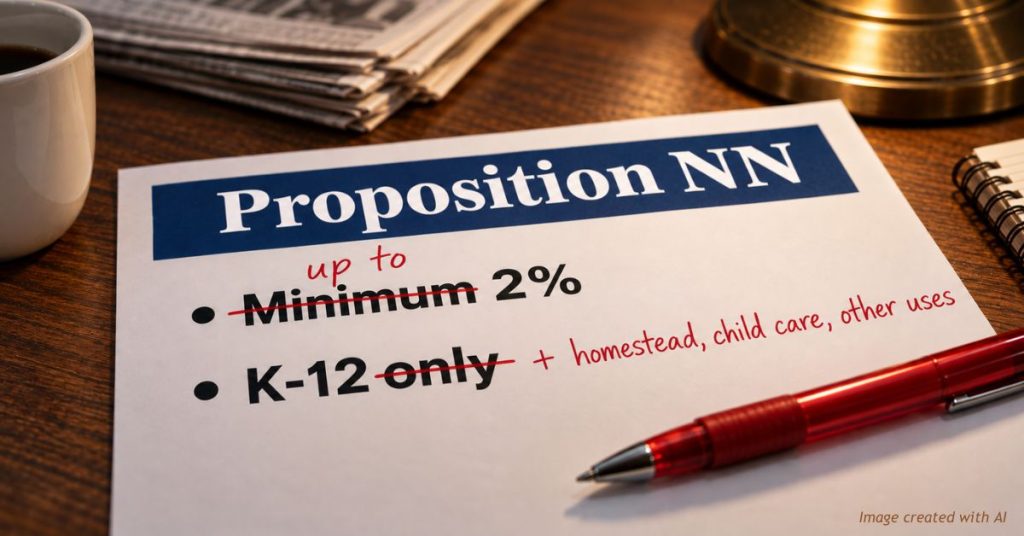
The official campaign for Proposition NN tells Colorado voters the measure “requires a minimum 2% annual funding increase” for local school districts.
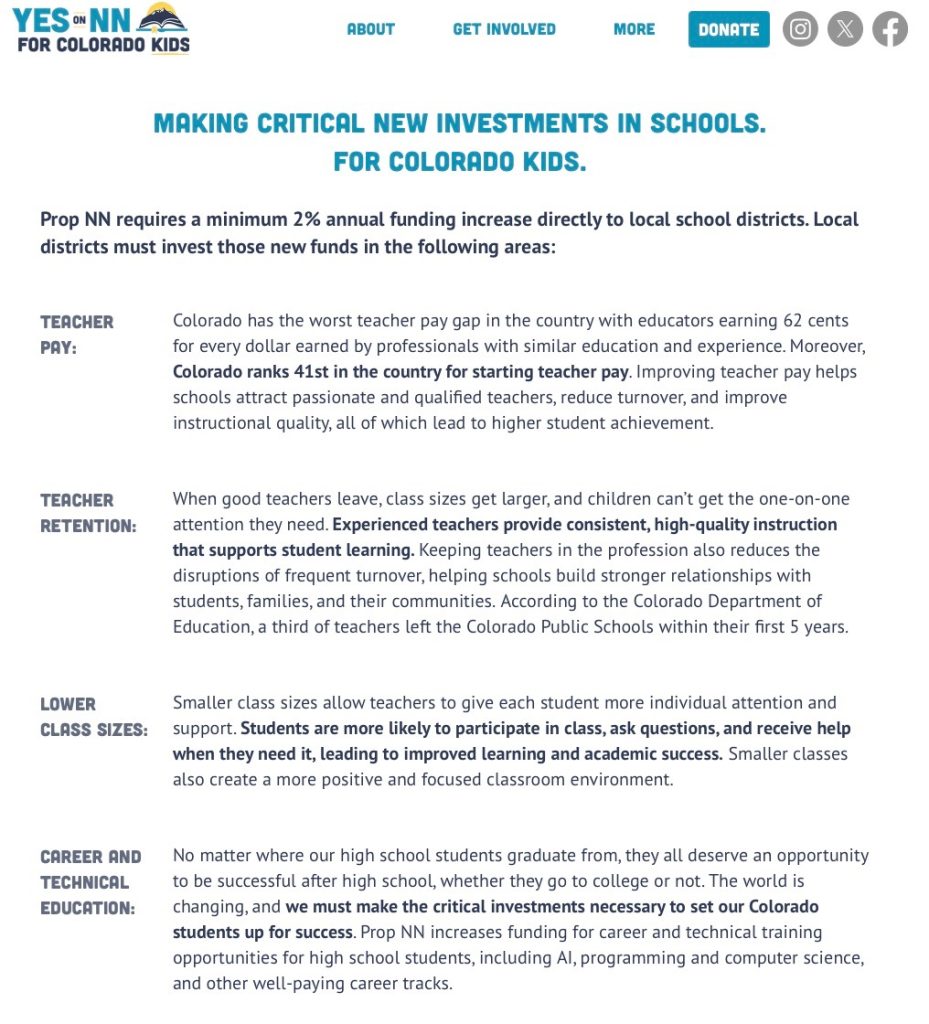
The Yes on NN campaign tells voters the measure “requires a minimum 2% annual funding increase directly to local school districts.”
Source: Yes for Colorado Kids
The state’s largest teachers union goes further.
On its campaign page, the Colorado Education Association says the money “is limited to K-12 only and cannot be used for anything else.”
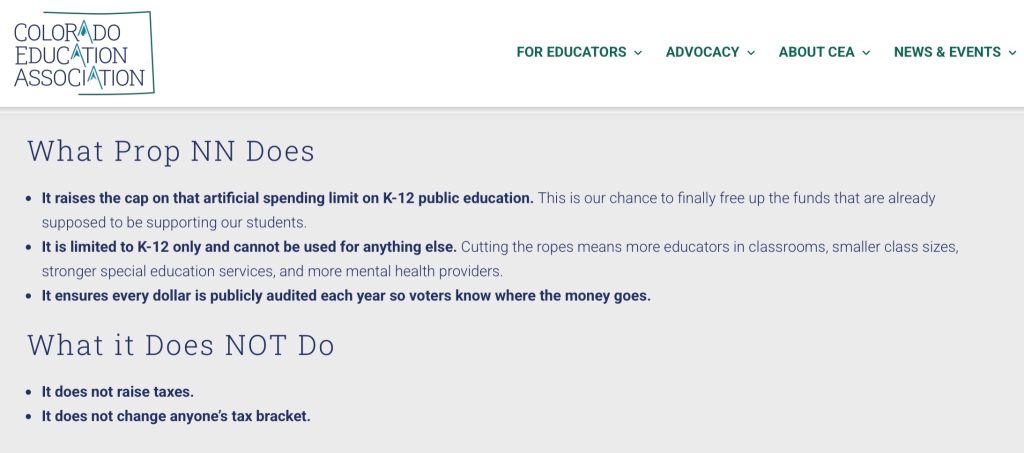
The Colorado Education Association’s Prop NN campaign page, captured Sept. 20, 2026.
Source: Colorado Education Association
Neither statement matches the law voters will be asked to approve.
Prop NN, referred to the Nov. 3 ballot through SB26-135 and sponsored by Democrat lawmakers, would let the state keep revenue it would otherwise refund to taxpayers under the Taxpayer’s Bill of Rights.
RMV checked what the campaign, the union and the bill’s Democrat sponsors are telling voters against the enrolled bill, the Legislative Council Staff analysis that will appear in the state’s Blue Book, the September state revenue forecast and the Common Sense Institute’s new Dollars and Data 2026 report.
The 2% isn’t guaranteed
The bill defines the annual increase as the lesser of two numbers.
One is a formula amount that adds 2% of the state’s share of school funding, and of the statewide total program once the new school finance formula phases in, on top of the previous year’s increase. The other is whatever revenue the state actually keeps above the TABOR cap.
If the surplus is smaller than the formula, schools get the smaller number. If there is no surplus, they get nothing.
The bill’s own declaration promises a 2% increase for at least ten years. The section that defines the increase qualifies it. The Blue Book says the teacher pay amounts are paid only if enough revenue is retained.
The Senate sponsors’ own March release described the measure as raising general fund K-12 funding by up to 2% a year.
Not K-12 only
Starting in 2027-28, the enrolled bill sends retained revenue first to reimburse local governments for the homestead property tax exemption for seniors, veterans with a disability and Gold Star spouses.
What is left goes into a new Children’s Account. In the first year, 2026-27, the whole retained amount goes into the account.
For the first 10 years, at least half of that account goes to K-12. The rest must go to “programs that support Colorado’s children, prioritizing child care, full-day preschool …” according to the bill.
After 10 years, the Blue Book says the retained revenue goes to K-12 education and any other purposes the Legislature decides.
Even House Democrats’ own May 9 release described the money as going to K-12 education and services for children, not K-12 alone.
The children’s programs language was added on the House floor when the bill was amended on second reading.
The version that had passed the Senate let leftover money be spent “for any other purpose.” The ballot title voters will read is identical in both versions. It promises an increase in “state investment in K-12 public education” and says nothing about child care or preschool.
Where the money actually goes
The campaign also tells voters that all new funds go straight to local school districts.
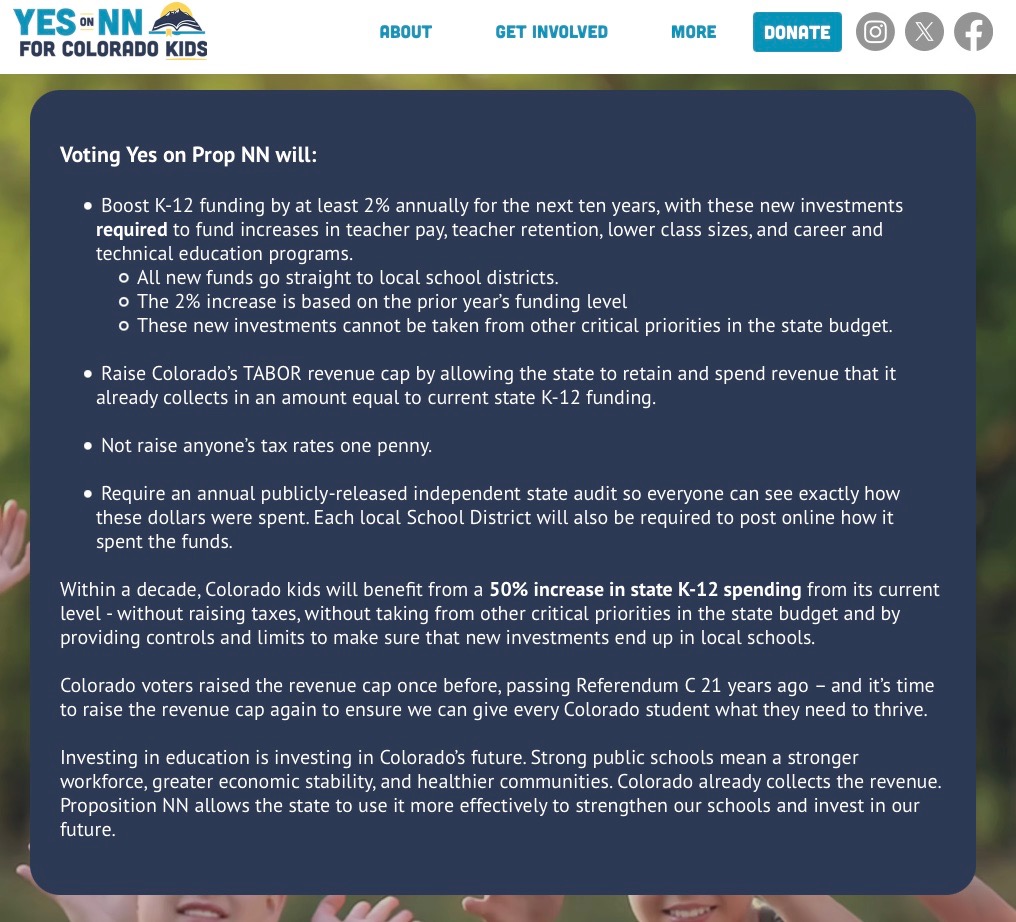
The Yes on NN campaign’s list of what the measure would do, including “All new funds go straight to local school districts” and a 50% increase in state K-12 spending within a decade.
Source: Yes for Colorado Kids
Only the positive factor, restricted to teacher pay, teacher retention, smaller classes and career and technical courses, goes to districts and charter schools by a set formula.
Homestead payments go to local governments, and lawmakers decide how the rest is distributed.
The Blue Book estimates about $110 million in the first year and $220 million in the second would go to school districts and charter schools by formula for those four uses.
Another $130 million and $20 million would go to school services, disability services and instructional hours. Children’s programs would get $241.5 million the first year and $234 million the second.
Set aside the homestead payments, and about $951 million goes into the new account over the first two years. About $330 million of that, or roughly a third, is tied to the four purposes printed on the ballot.
Those estimates use the June forecast.
The September forecast raised projected first-year revenue above the cap to $826.8 million. Legislative Council Staff has not published an updated allocation using it.
The 50% promise
The campaign site says Prop NN will raise state K-12 spending 50% within a decade.
The Colorado Children’s Campaign, citing proponents’ estimates, told supporters the measure could “boost annual K-12 funding by more than 50 percent over the next decade.”
Neither the Blue Book analysis nor the final fiscal note projects that.
Its only 10-year figure is for the positive factor, which it estimates could reach $1 billion to $2 billion a year by year 10. The Blue Book attaches the same condition. It is paid only if enough revenue is retained.
What the audit covers
Supporters promise an annual audit showing where every dollar goes. The bill directs the state auditor to describe how the state spent money from the account. It does not require the auditor to track how districts spend it.
Districts must post downloadable, sortable information about their positive factor spending online starting Aug. 1, 2027.
The final fiscal note assumes districts will not be required to report their use of the funds to the Department of Education. It budgets $20,000 for an audit contractor beginning in 2027-28.
More money, fewer students
Sen. Cathy Kipp, a prime sponsor, said in March that schools struggle every year to stretch limited budgets. Assistant Majority Leader Jennifer Bacon put it this way when the bill passed the House. “For years, our schools and teachers have been asked to do more with less.”
The data show more money and fewer students.
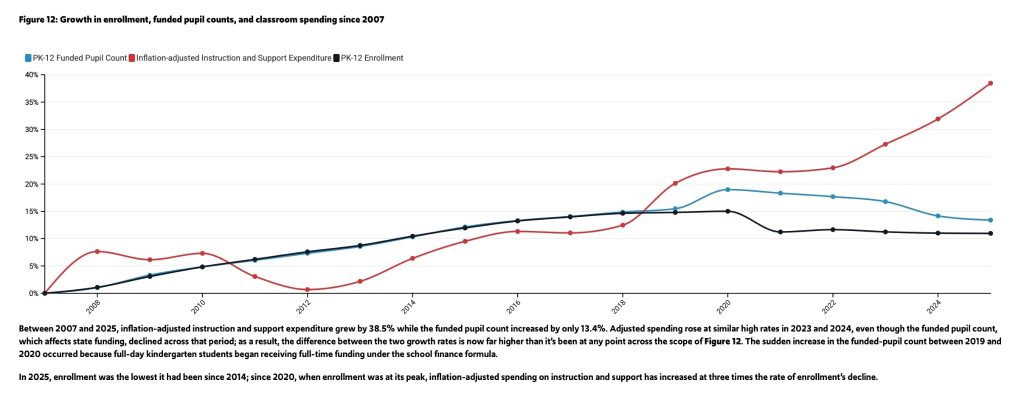
Inflation-adjusted instruction and support spending grew 38.5% between 2007 and 2025 while the funded pupil count grew 13.4%.
Source: Common Sense Institute, Dollars and Data 2026
According to the Common Sense Institute’s analysis of state education data, total public education revenue rose 48% from 2020 to 2025, from $14.5 billion to $21.4 billion, while enrollment fell 3.5%.
Spending grew 33% over the same period, from $14.6 billion to $19.4 billion.
The revenue total includes $1.66 billion in bond-sale proceeds from four large districts.
Using a narrower measure, inflation-adjusted spending on instruction and support grew 38.5% from 2007 to 2025. The funded pupil count grew 13.4%.
The institute’s separate Prop NN analysis also says Colorado’s per-pupil spending is well below the national average.
Democrat caucus releases also said the measure would help funding keep pace with population growth. Whatever the state’s overall population does, K-12 enrollment is falling.
It has now dropped six years in a row. Kindergarten enrollment is down 10.3% since 2020, and first grade is down 8.1%.
The negative factor ended in 2024
“For decades, we have underfunded our schools using the negative factor,” Sen. Jeff Bridges said in March. He called Prop NN a chance to turn that around.
Lawmakers eliminated the negative factor, known in state law as the budget stabilization factor, in 2024.
The school finance act that year, SB24-188, says its increased state appropriation was “thereby eliminating the budget stabilization factor.” When the bill cleared the Senate in April 2024, Senate Democrats announced it under a headline saying it would fully fund Colorado public schools.
“While we have much more to do to truly fully fund our schools, this bill represents a great start …” then-Sen. Rachel Zenzinger said at the time. Zenzinger is now a Jefferson County commissioner.
What it means for your TABOR refund
Prop NN does not change the income tax rate set in law. It changes what happens to money the state already collected above the cap.
State revenue fell $175.9 million short of the TABOR cap last year, so there is no refund for tax year 2026.
The September forecast expects surpluses to return.
Under Prop NN, the Blue Book says refunds would be eliminated for the next two budget years.
Under the Blue Book’s estimates, a single filer earning $50,000 would lose a $21 refund in 2027 and a $39 refund in 2028. A married couple earning $75,000 would lose $56 and then $86. A single filer at $100,000 would lose $28 and then $68.
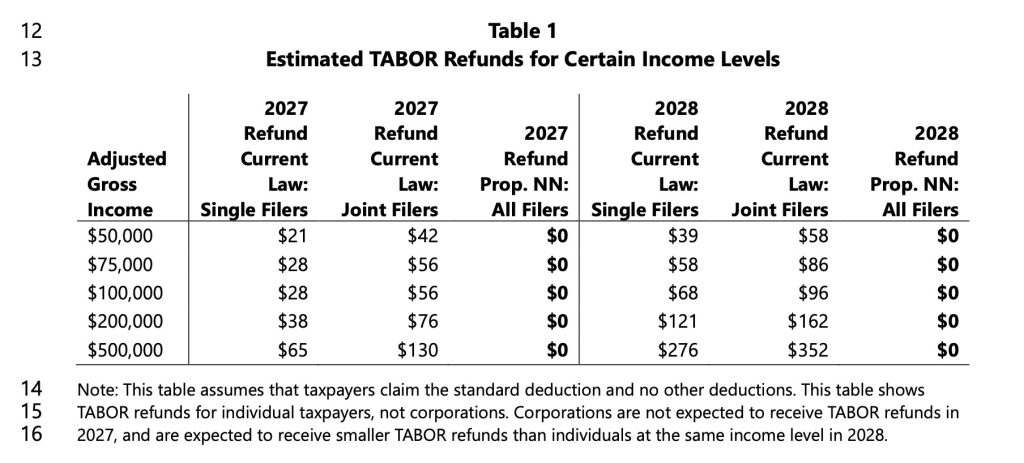
Estimated TABOR refunds by income level under current law and under Proposition NN.
Source: Legislative Council Staff, 2026 Blue Book analysis of Proposition NN
The new limit continues indefinitely, and the Blue Book says revenue is not expected to exceed it for at least five to 10 years.
In years when revenue lands between the old cap and the new one, refunds go to zero. In other years, the analysis says the loss could top $1,000 per taxpayer.
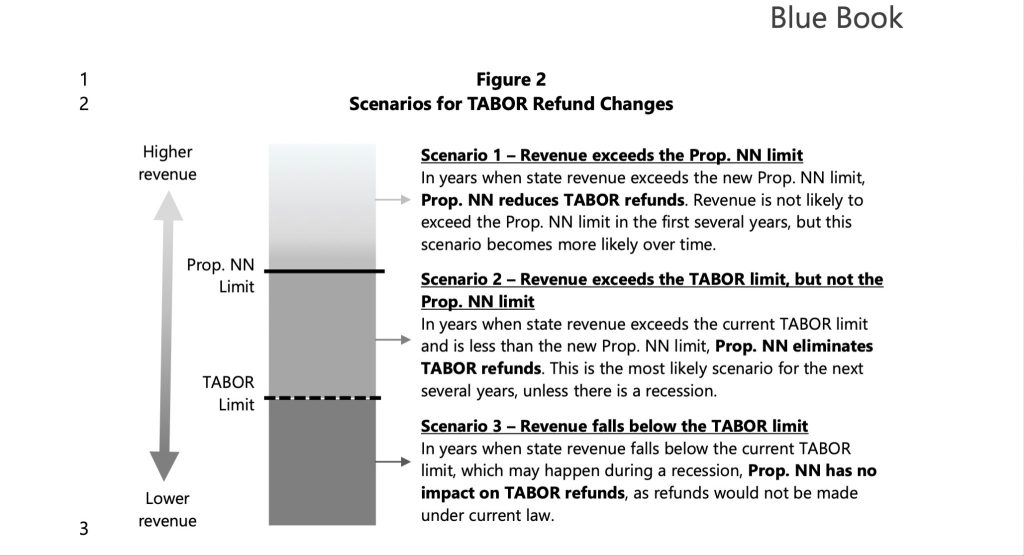
Three scenarios for what Proposition NN would do to TABOR refunds, depending on how much revenue the state collects.
Source: Legislative Council Staff, 2026 Blue Book analysis of Proposition NN
Legislative Council Staff says the projected surpluses of 2.6% to 3.9% of revenue are “well within normal error for forecasts.”
The homestead exemption continues. According to the fiscal note, the family affordability tax credit and the expanded earned income tax credit are not changed by the measure.
For working Coloradans, Prop NN doesn’t raise the rate they pay. In years revenue exceeds today’s cap but stays below the new Prop NN limit, the refund they would otherwise get stays with the state.
In the first two years, about a third of the money going into Prop NN’s new account goes to the four purposes named on the ballot.