
By Shaina Cole | Contributing Writer, Rocky Mountain Voice
State economists brought the Joint Budget Committee a number that sounds like relief. General Fund revenue is projected to grow 9.5 percent this fiscal year.
Then came the rest of the September forecast.
The same document that promises 9.5 percent growth also shows Colorado’s labor force shrinking at a pace the state’s own analysts say normally shows up only in a recession.
It shows the state keeping money it used to send back to taxpayers.
And it shows spending that Legislative Council Staff, the legislature’s nonpartisan forecasters, say is the real reason the budget keeps breaking.
Read past the headline and the improvement is less about a growing economy than about the state holding onto more of what it collects.
Growth that is mostly forecast
Start with what actually happened.
General Fund revenue grew 0.3 percent in the year that ended June 30. Not 9.5 percent. Total collections came in at $17.23 billion.
The 9.5 percent is a projection for the current fiscal year, the one that began July 1. It rests on assumptions about income taxes, tax credits switching off, and a rebound in corporate collections that fell off a cliff last year.
Individual income tax did rise 13.2 percent. But part of that reading reflects tax credits going away, not paychecks growing.
The forecast says the jump in refunds last year was driven by the Family Affordability Tax Credit and the expanded earned income tax credit, both available in full for tax years 2024 and 2025.
Those are state credits.
They are unavailable for 2026, and the forecast projects them staying off for 2027, because revenue growth fell below the level that keeps them on.
When a refundable credit turns off, the state keeps money it would have paid out. Revenue rises. Households get less back.
A corporate number that lies both ways
Corporate income tax collections dropped 40.9 percent in a single year.
That looks like a business collapse. It is not.
LCS attributes the drop to federal accounting. The One Big Beautiful Bill Act changed the timing of several business deductions, including bonus depreciation.
Companies had paid under the old rules, then filed for large refunds once their liability fell under the new ones. Refunds nearly doubled.
The forecast expects corporate revenue to climb back 13.4 percent this year and keep rising toward $2 billion by fiscal 2028-29, a recovery it says strong corporate profits will help support.
So the 40.9 percent plunge overstates any real weakness, and the coming rebound partly reflects the same federal changes working back through the books.
The part the summary slide skips
The forecast’s economic section is where the mood changes.
Colorado’s labor force has been shrinking since late 2024. Through July it was down 2 percent from a year earlier, almost 67,000 workers. That kind of sustained decline, the forecast says, “historically has occurred only during a significant economic downturn or disruption such as the pandemic or the Great Recession.”
The share of working-age Coloradans in the labor force fell to 65.5 percent in July, the lowest since at least 1976 outside the pandemic.
The forecast points to several factors that may have fed the decline, among them shifts in federal immigration policy, affordability, weak wage and job growth, and falling migration into the state from elsewhere in the country and abroad.
The unemployment rate stayed near 3.9 percent.
Nationally, a separate measure showed more strain, the forecast says: the share of unemployed people out of work for six months or longer rose to 27 percent by August.
One sector is holding up the Colorado jobs count. Education and health services added 15,500 jobs over the year. Without that supersector, Colorado would have lost 3,400 jobs.
The Common Sense Institute, which rates the state’s year-over-year job growth as average, recorded the next month going the wrong way. Colorado lost 1,400 jobs in August. Unemployment ticked up to 4.0 percent. Labor force participation fell for the seventh straight month.
Keeping more of the surplus
Here is where the revenue story and the ballot meet.
State revenue is now expected to run above the Referendum C cap, the limit on what Colorado can keep and spend, by $826.8 million this fiscal year. Money over that cap is normally refunded. This year, less of it will be.
HB26-1419 reduces refunds to recover an earlier over-refund.
Proposition MM, the school meals tax voters passed last November, is bringing in more than voters were told.
The ballot said $95 million. The bill’s fiscal note projected $106.5 million for 2026-27 before the vote, and warned then that the overage might force another refund or another trip to the ballot.
The September forecast now puts the number at $132.1 million, an overage it says “could necessitate either approval of another ballot question to retain the excess, or that the excess be refunded to taxpayers.”
A new diversion, the Kids Matter Account, routes $237.1 million in income tax into a state education account before it reaches the General Fund.
On the November ballot, Proposition NN, created from SB26-135, asks voters to permanently raise the state’s spending limit and let it retain revenue that would otherwise be refunded.
CSI estimates that it will end $850.9 million in refunds through 2028, costing a filer earning $50,000 about $60 and one earning $100,000 about $96.
Amendment 87, formerly Initiative 195, would replace the flat income tax with graduated rates and exempt the new money from refund rules.
The direction is not new.
RMV has reported on the school funding measure since it cleared committee in March, and on the competing income tax measures in August.
Attorney General Phil Weiser, who is running for governor, folds it into his platform.
His Colorado Blueprint says he will work to “change our constitutional limits on how we fund our core priorities,” including “allowing the state to keep and transparently invest excess dollars we collect in good economic times.” Across 109 pages, the plan never uses the word refund.
Spending is the driver, by the state’s own account
The forecast states that most of the deterioration since June is “on the expenditures side, rather than a result of changes to the revenue forecast.”
Medicaid ran about $200 million over its appropriation last year, most of a $213.1 million overexpenditure that left the reserve $140.7 million short of what law requires.
Looking ahead, LCS built an illustrative scenario that adds current-law pressures.
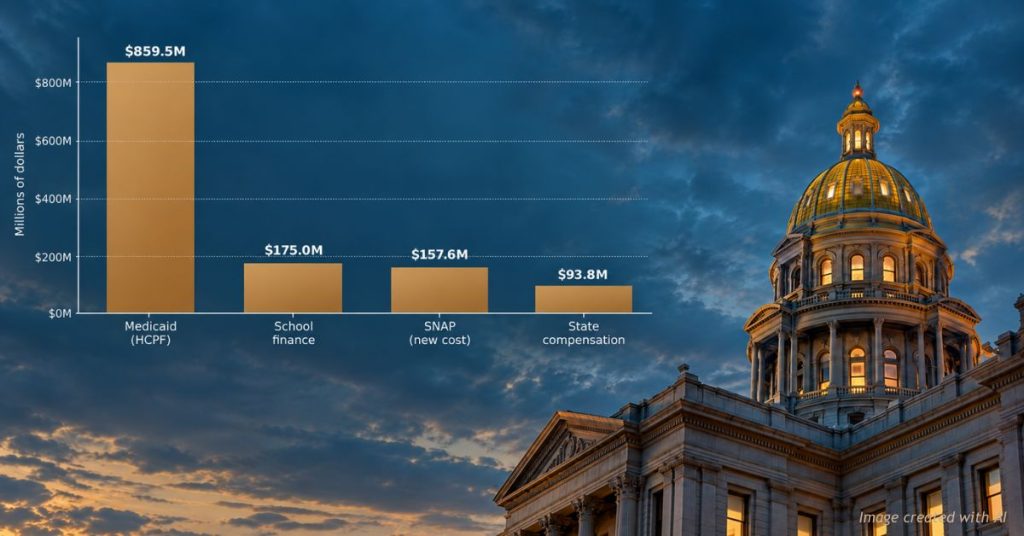
Under it, the state ends the 2027-28 year $1.58 billion below its reserve requirement. The largest single piece is the Department of Health Care Policy and Financing, up $859.5 million, driven by a homemaker and personal care program expanded in July 2025.
A new SNAP obligation, triggered when the state’s payment error rate crossed 10 percent under federal law, adds another $157.6 million the General Fund never carried before.
Those costs, the forecast says, will “crowd out space under the state TABOR limit,” leaving less for everything else.
What the numbers add up to
The year-end books are not final.
The September forecast says that on September 15, the State Auditor notified the governor and legislative leadership that documentation was insufficient to complete an audit of the revenue certification, and that year-end accounting is incomplete and subject to change.
What the forecast shows now is a state collecting more while the base under it thins.
Fewer workers. Weaker migration, from other states and abroad. A revenue line propped up by credits expiring, a federal accounting swing, and a growing list of dollars the state keeps instead of returns.
The 9.5 percent is real on paper.
Under it, the workforce the number depends on has been shrinking for almost two years.