
By Jen Schumann | Rocky Mountain Voice
Colorado election officials said they diverted staff to evaluate President Trump's executive order while 2026 preparations were already underway. USPS said the proposal formalizes election-mail practices it has recommended for years. The dispute has now moved to the appeals courts.
Colorado election officials told a federal court they began evaluating changes to the state’s election systems almost immediately after President Donald Trump signed an executive order directing federal agencies to overhaul parts of federal election administration.
In sworn filings, they said the order required them to divert staff time to analyze how new federal citizenship verification and ballot-mail procedures would interact with the state’s systems while preparations for the 2026 election were already underway.
Colorado runs a near all-mail system, and 92.2 percent of ballots cast in the 2024 general election were mail ballots.
Colorado says planning began immediately
Hilary Rudy, Colorado’s deputy state elections director, told the court that as soon as her team had read the executive order, she began weighing the near-term steps it would require: building a state voter list, checking it against new federal lists, drafting guidance for county clerks, educating voters and building out data-analysis and cybersecurity work.
She said all of this would compete with the work the department was already doing to certify statewide ballot content, support counties and prepare military and overseas ballots.
State officials cite challenges matching voter records
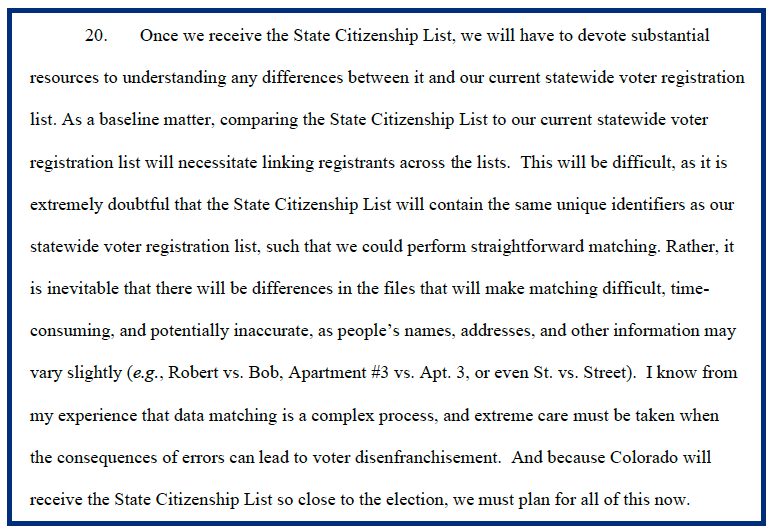
Rudy told the court the hardest part would be comparing a new federally generated “State Citizenship List” against Colorado’s constantly changing voter registration database.
Rudy told the court the comparison would require linking records that likely will not share the same identifiers or formatting. She illustrated the problem with examples such as “Robert” versus “Bob” or “Apartment #3” versus “Apt. 3,” saying slight differences could complicate automated matching, force manual review and lead to errors that affect eligible voters.
Mail-ballot proposal creates a second layer
The executive order also directed the U.S. Postal Service to begin rulemaking governing ballot mail used in federal elections.
USPS published a proposed rule June 2 that would set new standards, including requirements for ballot-envelope preparation, Intelligent Mail barcodes and state-specific participation lists. Colorado officials told the court those federal processes would run alongside the state’s own systems mid-cycle.
USPS says the rule builds on longstanding election-mail practices
At a June 24 Senate hearing on the Postal Service’s finances, Postmaster General David Steiner defended the proposed rule as mostly turning existing USPS election-mail guidance, known as Kit 600, into mandatory standards. He noted states across the political spectrum already follow it. “All this does is make it a requirement,” Steiner said.
Steiner rejected the idea that USPS was becoming an election administrator. Asked whether the Postal Service is an election administration agency, he said, “No, absolutely not.” He described the voter list as “strictly a manifest” that lets the agency confirm the right ballots reach the right voters, and said USPS would not review whether a voter is properly registered or refuse delivery to a voter a state says is registered.
“Not our function,” Steiner said. “We deliver mail.”
Steiner did draw one limit, at the level of the state rather than the voter. Pressed by Sen. Gary Peters on what would happen if a state declined to hand over its list, he was asked whether USPS would still mail those ballots. “Under our proposed regulation, no,” he said. He stressed the rules were proposed rather than final, with the comment period still open.
That comment period has since closed. It ended July 2, and USPS is now deciding whether to withdraw, revise or finalize the rule. The agency has not said which path it will take. Under the executive order, any final rule is due in late July, though two court rulings blocking implementation now complicate that timeline.
Federal agencies said key decisions hadn’t been made
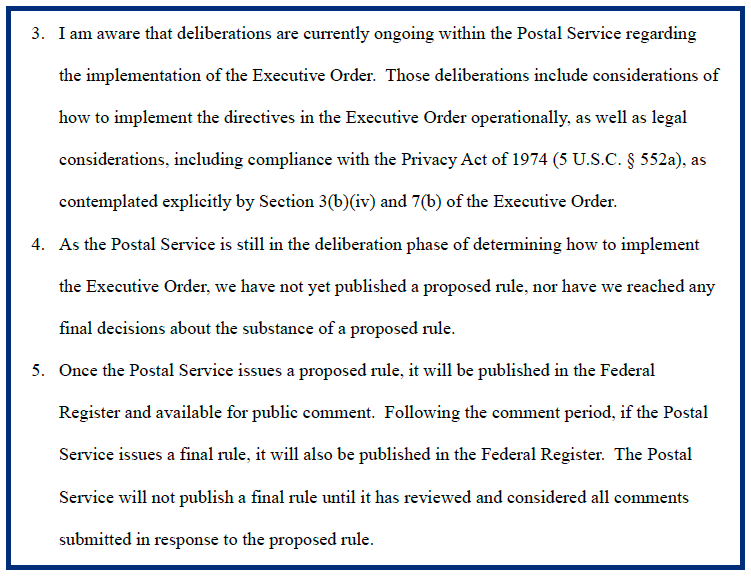
In court filings, federal agencies said they were still deliberating and had not reached final decisions on how to carry out the order. Those declarations, filed in early May by U.S. Citizenship and Immigration Services, the Social Security Administration and USPS, each described a different piece of that unfinished work.
USCIS said it had not created any State Citizenship Lists and had not decided which databases it would use. The Social Security Administration said it had made no final decisions about its role. USPS said it had not yet published a proposed rule or settled its substance at the time of its May declaration. The Postal Service published the rule the following month.
A fight over timing
The question of when the executive order could be challenged ran through the case. At a June 2 hearing, Justice Department attorney Stephen Pezzi argued the challenge was premature because no federal list or final rule yet existed.
Judge Indira Talwani pressed him, framing the government’s position aloud: “That nothing is happening here. There’s no there there.” She said her focus was narrower than the distant future, the elections “between now and November 3rd and including November 3rd.” The states countered that the costs had already begun, pointing to declarations like Rudy’s.
Court ruling
Colorado joined a coalition of states challenging Executive Order 14399 in federal court.
In a June 25 ruling, Talwani dismissed the states’ claims about elections after Nov. 3, 2026 as premature, but on the 2026 election she sided with them. She granted the plaintiff states summary judgment, declaring Sections 2 and 3 of the executive order unconstitutional and void as beyond presidential authority, and finding its five-year records-retention provision advisory rather than mandatory.

The government had conceded that last point at the June 2 hearing, telling the court Section 5 imposed “no mandatory obligation on the states.” She barred the agencies, including USPS, from enforcing Sections 2 and 3 against the plaintiff states for the 2026 election. The ruling does not reach elections after 2026.
Colorado joins USPS challenge
On July 2, Attorney General Phil Weiser joined 23 other attorneys general in a comment letter urging USPS to withdraw its proposed ballot-mail rule.
“This is another unlawful attempt by the Trump administration to seize control of elections that are administered by the states,” Weiser said. He added that Colorado is “a national leader in secure, accessible elections, and we won’t stand by while the federal government tries to rewrite the rules and create new barriers for eligible voters.”
Two appeals, two legal questions
On July 7, Talwani entered final judgment and denied the government’s request to pause her injunction while it appeals. She allowed only a seven-day administrative stay so the government could renew the request before the appeals court.
Two sets of appeals are now before the 1st U.S. Circuit Court of Appeals. The Trump administration appealed July 2. Twelve Republican-led states that intervened to defend Trump’s executive order, Alabama, Florida, Indiana, Kansas, Louisiana, Missouri, Montana, Nebraska, Oklahoma, South Carolina, South Dakota and Texas, filed their own appeal July 6.
The intervenor states made a different argument than the administration. The administration said it was too early to sue because the new system didn’t exist yet. The intervenors went further: they said no one had actually been harmed, and no one would be unless a long chain of future events lined up, the final rule, then each state’s choices, then each county’s.
Until an actual voter was actually turned away, they argued, there was nothing to sue over. If that day came, their lawyer told the court on June 2, the states could “sue them” then.
Talwani disagreed. She ruled the states had a real stake in the case now, not someday, and on July 7 she found both the administration and the intervenors “unlikely to succeed on the merits of their appeal.”
Separately, on July 1, U.S. District Judge Emmet Sullivan in Washington blocked USPS nationwide from carrying out the plan, ruling it conflicted with the Postal Service’s 2021 settlement of an NAACP lawsuit over election-mail delivery. USPS has appealed that ruling as well.
Although both appeals grow out of the same executive order, they raise different legal questions. The First Circuit will review Talwani’s constitutional ruling. The Washington appeal asks whether USPS’s proposal breaks its earlier settlement with the NAACP.