
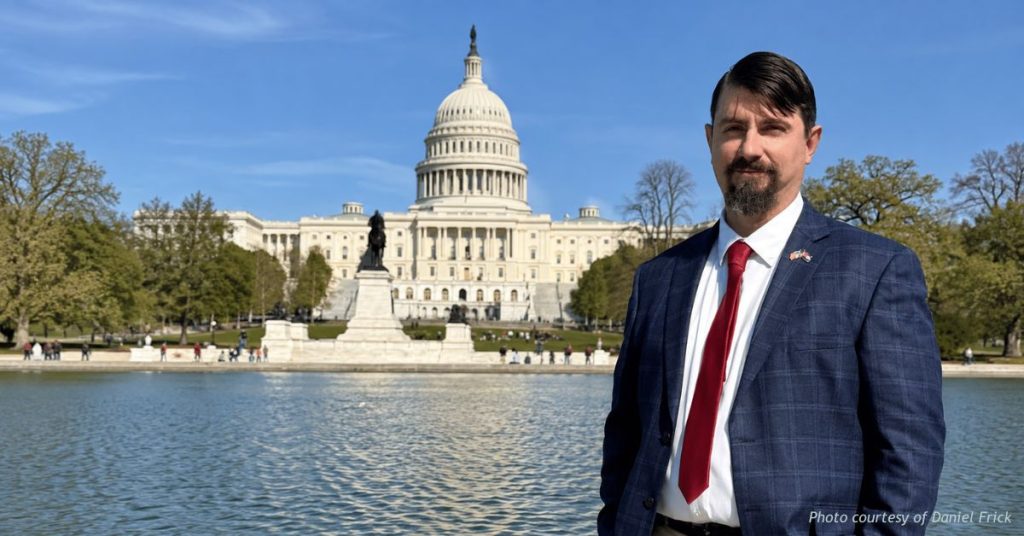
By Shaina Cole | Contributing Writer, Rocky Mountain Voice
Daniel Frick did not like politics growing up. He thought it was drama and theater, the same way, he figures, most people do. Then his stepdaughter was hit by a car and left permanently disabled, and the family found itself in what he calls the dark corners of the state, where her case sat forgotten.
Now he is a Republican running for Colorado House District 53, a Democratic-held Fort Collins seat. By Frick’s telling, the district has been blue since 1986.
“I’m not running for me. I’m running for Carissa,” Frick said. “I’m fighting for Carissa. That’s what this whole campaign is about, getting justice, holding people accountable and changing our state’s political system so that other people don’t end up like Carissa and other families don’t end up like ours.”
Carissa was permanently disabled in a hit-and-run crash in March 2025. His wife Patti moved to Parker to care for her full time. Frick stayed in Fort Collins to raise the children still at home. For more than a year, they have run two households and lived apart. They were married seven months before the crash.
The everyman pitch
Frick, an Air Force veteran who later deployed to Afghanistan as a contractor, calls it an “every man’s campaign.” He is a paid caregiver for his son through Medicaid. He says he pays the same rent, buys the same groceries and fills up at the same pumps as everyone else in the district.
That framing is the whole strategy in a seat Republicans do not win. Frick says he has been targeting unaffiliated voters, who by his count make up 52% of the district, and older Democrats who remember a less divided time.
“Hearing the term Republican in Fort Collins doesn’t mean I’m Trump,” he said. “It doesn’t mean that I’m anti-education. I pay the same taxes. I just want people to be able to enjoy living in their homes, living in their communities, just thriving.”
He is being outraised by a wide margin, and he knows it. He says his answer is reaching voters directly and showing them, without spin, what has moved through the legislature.
Affordability first
Frick’s campaign site lists lowering the cost of living as its first issue, and he returns to it constantly. He wants to cut what he calls red tape in residential permitting so builders have a reason to put up attainable housing rather than only larger, more profitable homes.
He does not name a specific statute he would target. He points instead to a pattern he says he heard from a member of the local Board of Realtors, that it can cost roughly the same to permit a small two-bedroom home as a much larger one, which pushes developers toward size.
By his account, every $1,000 increase in the price of a new home prices roughly 2,000 would-be buyers out of the market.
He also says he would defend TABOR and push back on rising utility costs and hidden fees.
Victim-centered justice
The core of Frick’s platform is the Carissa Amendment, a set of changes his site frames as stronger penalties for serious-injury hit-and-run cases and guaranteed victim input in bond and sentencing decisions.
He describes it from lived experience, and he is careful to say so. He says that after the crash the family heard from the Arapahoe County district attorney’s office and victim advocates for a few weeks, then nothing. He says the initial police report listed everyone involved as a citizen, and that the family did not learn the driver was in the country illegally until months later.
“To go from March 28th to January 16th and nobody followed up with Carissa,” Frick said, describing the stretch he says passed before his wife wheeled Carissa into a hearing so the court could see her.
Asked how he answers critics who say mandatory-style sentencing does not deter crime and drives up incarceration costs, Frick did not claim hard data. He argued the state should address why people offend before it worries about the cost of jailing them.
“People don’t go to prison if they don’t commit crimes,” he said. “So let’s address that first and then look at the incarceration costs.”
Parental rights and education
Frick, the son of an Air Force chaplain and a public school teacher of 51 years, attended schools across several states and countries as a kid. He says the math and the reading standards were the same everywhere, and that is what he wants for Colorado’s youngest students, a common academic foundation before electives and sports enter the picture in the older grades.
He frames parental rights not as book banning but as hierarchy.
“Parental rights isn’t about restricting teaching,” he said. “Parental rights is about remembering and understanding that there is a hierarchy in a child’s life. And it doesn’t go principal, sixth grade teacher, school counselor, basketball coach, and then mom and dad. It goes mom and dad in care of this school.”
He wants curriculum transparency so parents know what their children are being taught. And though he is a Christian, he says religion belongs at home and in private schools, not in a public classroom.
“Yes, I am a Christian, but we need to keep religion out of public school,” Frick said. “It should just be an environment where kids are learning and it should have a strong foundation.”
Parents who want a religious grounding in their child’s education, he says, should be free to choose a school that provides it. What he objects to in public schools is the same thing whether it comes from faith or ideology, adults introducing children to material he believes belongs to the parents.
Medicaid and mental health
As his son’s paid caregiver, Frick says he has seen the system fail up close. He describes his son losing long-term Medicaid coverage for about 60 days last year over what he calls a paperwork issue, while the system still showed him as active on Frick’s end. He watched his wife spend months trying to become a paid caregiver for Carissa through a process he found far harder than his own.
On policy, he says he would start by auditing programs he believes have ballooned without scrutiny. He offered two examples, one of which he said outright he had not fully verified.
The first was ABA therapy, a service his daughters received. He says the hourly rate held steady between 2019 and 2023, but the total cost to the state climbed 172% while Colorado’s population grew less than 3%. “Who’s auditing those programs?” he asked.
The second was non-emergency medical transport, and this is the one he said he had not confirmed. He says he had been told that operators launched transport companies and used them for trips that were not medical, which pushed Medicaid to cap what it would reimburse per mile. His father, a volunteer driver for a senior nonprofit in rural Teller County, then saw the program stop serving some clients unless it could group their medical appointments together.
“When I get elected, I’m going to make sure that we take a closer look at this,” Frick said, “that we start auditing a lot of these programs to make sure that our money that people are paying taxes for, these services are actually getting used and utilized by the people that need them, rather than just seeing it as a piggy bank for certain groups.”
The Second Amendment
Frick is running against an incumbent who was a prime sponsor of SB25-003, the 2025 law that, as of August 2026, restricts the sale and transfer of certain semiautomatic firearms. He wants it gone. He says the incumbent told the Larimer County sheriff he wants to expand the law to cover all handguns in the next legislative session.
“Nothing is settled when it comes to the Second Amendment,” he said. “‘Shall not be infringed’ means leave my guns alone. If I’m a law-abiding citizen, don’t pass legislation that then makes me a criminal because I own something.”
He rejects the restrictions in the law, arguing there is no such thing as an assault rifle and calling what gun-control advocates label high-capacity magazines standard capacity. He is quick to say he is not describing a free-for-all.
“I’m not saying that I can walk into a sportsman’s warehouse and buy 10 shotguns, 10 AR-15s …,” Frick said. “I’m just saying that we have the rights to own and shoot guns and use them however we see fit.”
The point of the amendment, he says, was never hunting. It was to hold a government in check.
The long shot
Frick is candid about the odds and about his own party’s record in Larimer County. He says he has been told, by elected officials he would not name, that his story is worth sharing but that he will get no funding and will not win.
He is running anyway, and he says part of the point is building something that outlasts this race, a blueprint for finding candidates who can compete in northern Colorado in the cycles to come.
“My ultimate goal is not to flip Colorado completely red,” he said. “It’s to find that balance … so that everybody feels represented and we’re able to collaborate and work together.”
The campaign still comes back to one person. Patti travels and speaks as an angel mom, Frick says, and he wants to be the one who turns those words into action at the Capitol.
“When Patti is going and she’s making these impactful statements, she’s bringing awareness to what happened with Carissa,” he said. “She has somebody behind her that is then taking action to those words.”
He says something shifted in the way the state treats the people who live in it, and that it pulled him off the sidelines.
“At some point along the way, Colorado state government stopped serving its people and instead expected its people to serve its government,” Frick said.
“I’m just a guy running to protect his family. And as a result, look out for all Coloradans.”