Rocky Mountain Voice

Tag: Fiscal Policy

From $8 Billion to $16 Billion: How Colorado’s Medicaid Budget Doubled in a Decade
Rocky Mountain Voice, State, Top Stories

From $8 Billion to $16 Billion: How Colorado’s Medicaid Budget Doubled in a Decade

By Shaina Cole | Contributing Writer, Rocky Mountain Voice If you ask most Colorado families how they feel about health care right now, the answers aren’t complicated. It’s expensive.It’s confusing.It keeps going up. And for taxpayers helping fund Colorado’s Medicaid program — known as Health First Colorado — another question has started to surface: If enrollment has come back down, why hasn’t spending followed? Ten years ago, Colorado’s Medicaid agency operated on roughly $8 billion. Today it’s closer to $16 billion. The Common Sense Institute (CSI) calculates that as 101 percent growth over the decade. CSI reports that the rest of the state operating budget grew 64 percent during that same period. The story of enrollment is different. ...
Federal Reimbursement Model of ‘Perverse Incentives’ Fuels Colorado Medicaid Expansion
Complete Colorado, Approved, Commentary, State

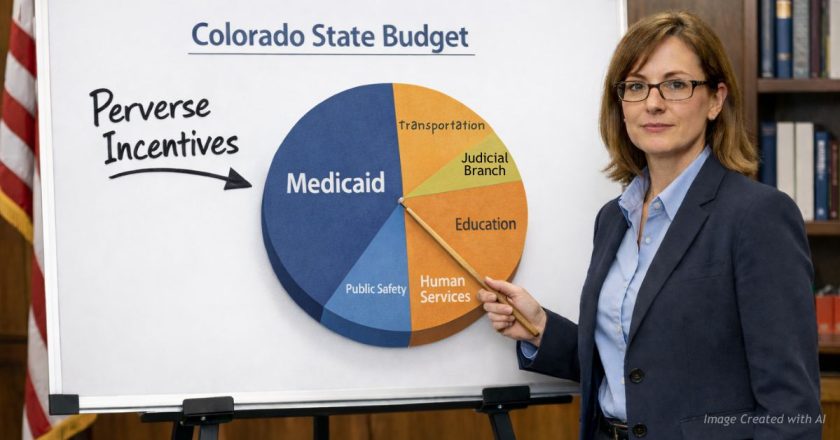
Federal Reimbursement Model of ‘Perverse Incentives’ Fuels Colorado Medicaid Expansion

By Nash Herman | Commentary, Complete Colorado Colorado’s ongoing budget-gap struggles are the predictable result of structural problems with Medicaid.  Paragon Health Institute, a non-partisan research institute, recently published a new report, Preserve and Improve Medicaid, which explains the program’s inherent challenges and how states such as Colorado can take advantage of One Big Beautiful Bill (OBBB) reforms to improve outcomes.  However, it remains ultimately up to Colorado legislators to address the program’s systemic issues.  Medicaid’s ‘perverse incentives’ As economist Linda Gorman recently explained, the rapid 2010 expansion of Medicaid did not produce large gains in physical health, suggesting that the new expansion ...
Colorado Lawmakers Face Tough Choices As Medicaid Drives Increased Spending
Colorado Politics, Approved, State

Colorado Lawmakers Face Tough Choices As Medicaid Drives Increased Spending

By Marianne Goodland | Colorado Politics This week, the state Senate is reviewing revisions to the 2025–26 state budget, which has been reduced by hundreds of millions of dollars in each round of cuts. But the bottom line is that, because of Medicaid costs, the state will spend more in 2025-26 than lawmakers approved in the 2025 session. Last week, the 29 bills in the supplemental package were approved by the House, with most passing with broad support. That didn’t mean all of them did: bills changing the budgets for the departments of state, treasury, health care policy and financing, personnel, public health and environment and higher ed all passed largely along party lines. A supplemental for the Department of Corrections, which increased its budget by $29...
Democrat TABOR Revenue Reclassification Plan Draws Scrutiny at State Capitol
Complete Colorado, Approved, State

Democrat TABOR Revenue Reclassification Plan Draws Scrutiny at State Capitol

By Nash Herman | Complete Colorado Similar to last year’s Senate Bill 173, legislative Democrats are returning this year with another effort to bypass Colorado’s Taxpayer’s Bill of Rights (TABOR) by reclassifying certain state revenue streams.  While Senate Bill 26-042 may have some plausibility under specific TABOR terms, it raises broader concerns about the runaway growth of Colorado’s state government, and the mechanisms legislators pursue to evade voter consent over taxation.  What the bill does  While TABOR generally limits the growth of a portion of state revenue to a modest formula of population growth plus inflation, it allows for certain carve outs such as “damage awards” and “collections for another government.”  ...
“America must not be overwhelmed”: A century-old warning revisited
Rocky Mountain Voice, Commentary, National, Top Stories

“America must not be overwhelmed”: A century-old warning revisited

By Tom Anthony | Guest Commentary, Rocky Mountain Voice Founding Father Alexander Hamilton, who penned the lion’s share of the Constitution, is perhaps the most stellar example of the philosophy of America as a meritocracy, having been the illegitimate son of a Caribbean storekeeper who rose to become George Washington’s Adjutant and the first Secretary of the Treasury. He said this about immigration: “Foreigners will generally be apt to bring with them attachments to the persons they have left behind; to the country of their nativity, and to its particular customs and manners. They will also entertain opinions on government congenial with those under which they have lived; or, if they should be led hither from a preference to ours, how extremely unlikely is it that they will...
Lawmakers admit the problem: One-time money built permanent government
Colorado Accountability Project, Approved, Commentary, State

Lawmakers admit the problem: One-time money built permanent government

By Cory Gaines | Commentary, Colorado Accountability Project Reporters talk about shared reality, some want it to be their reality. Over and over I have heard and read journalists discussing our "shared reality"--the need to operate from a basis of fact.I don't disagree.The problem is that many of those same journalists want to substitute their take on reality, they want to be the arbiters of fact.This is not their role.I wrote an op ed on this dynamic using some statements and "reporting" by 9News' Zelinger and Clark as an example.More on the topic in the link below.https://completecolorado.com/2026/01/08/colorado-journalists-shared-reality-deciders/ Were it not for TABOR (weakened as it is) … I wanted to share the Sun article below, but per...
How Medicaid growth is crowding Colorado’s budget priorities
Colorado Accountability Project, Commentary, State, Top Stories

How Medicaid growth is crowding Colorado’s budget priorities

By Cory Gaines | Commentary, Colorado Accountability Project Medicaid and Colorado’s Spending on Same I wanted to share Nash Herman’s op ed from Complete Colorado with you. I will leave it to you to read it in full, but there are a couple of pertinent things to share. The op ed does a good job of providing an overview of what will likely be a big issue this legislative session: Colorado’s Medicaid spending, a largely self-caused injury. In typical government fashion, the relevant state department, the Department of Healthcare Policy and Financing, engaged a third party and paid them $600K to study the issue. The contractor came back and recommended that, quoting the op ed, “... the state should prioritize reductions in behavioral health, long-term...
Congress Braces for Partial Shutdown as Spending Fight Intensifies
Washington Examiner, Approved, National

Congress Braces for Partial Shutdown as Spending Fight Intensifies

By Emily Hallas | Washington Examiner Congress is careening toward the second government shutdown in four months due to disagreements over federal funding for Immigration and Customs Enforcement. The shutdown Washington is preparing for this weekend has several key differences from the government funding battle last fall. That 43-day shutdown became the longest in U.S. history, ending in November 2025. It centered on Democrats’ concerns that legislation to keep the government open did not contain a provision to extend Obamacare subsidies. And before the shutdown was triggered on Oct. 1, it was widely expected due to the known deadline for renewing the expiring Obamacare subsidies. Unlike last fall’s controversy, the latest looming government shutdown w...
Colorado Lawmakers Acknowledge Shared Responsibility for Budget Crisis
The Colorado Sun, Approved, State

Colorado Lawmakers Acknowledge Shared Responsibility for Budget Crisis

By Jesse Paul | The Colorado Sun Nonpartisan staffers told lawmakers this month that the way they spent billions of dollars in one-time federal funds given to Colorado during the COVID pandemic contributed to the state’s budget shortfall. he Colorado legislature is at least partially to blame for the structural deficit forcing lawmakers this year to cut state programs and services to address a roughly $850 million funding shortfall.  The General Assembly contributed to the deficit through its handling of billions in one-time federal funding that flowed into Colorado during the coronavirus pandemic, nonpartisan staff for the legislature’s powerful Joint Budget Committee told the panel earlier this month. At issue was how some of that money was used...
Stop the bleeding: Fraud, tariffs and the reality of a $1.8 trillion deficit
American Thinker, Approved, Commentary, National

Stop the bleeding: Fraud, tariffs and the reality of a $1.8 trillion deficit

By Brian C. Joondeph | Commentary, American Thinker The U.S. federal government finished Fiscal Year 2025 with about $7 trillion in outlays and just over $5 trillion in revenues, leaving a deficit of roughly $1.8 trillion -- a gap that adds to the exploding national debt and threatens economic stability.  Under current trajectories, deficits are projected to remain near this scale for the foreseeable future, absent dramatic policy changes. What if, as some argue, the solution is staring us in the face: eliminate waste, fraud, and abuse across government programs and pair that with stronger tariff revenues?  Could that alone balance the budget without cutting core programs or raising taxes? Is this wishful thinking or a real possibility? There...